AI for Apparel Manufacturing & Merchandising | MerchLY.AI

MERCHLY.AI | AI FOR APPAREL MANUFACTURERS
AI Agents For Apparel Merchandising Execution
Turn changing buyer requirements into decision-ready actions across your merchandising operation.

THE HIDDEN OPERATIONAL LAYER
Much of Merchandising Still Happens Between Systems
Buyer requirements change constantly. Understanding what changed, what it affects, and what needs to happen next still requires significant human interpretation and coordination.

BUYER REQUIREMENTS KEEP CHANGING
Requirements evolve across emails, tech packs, specifications, quantities, and delivery requests.

EVERY CHANGE CREATES IMPACT
Revisions affect materials, planning, procurement, production, costs, and delivery commitments.

CONTEXT SITS ACROSS SYSTEMS
Information spans documents, spreadsheets, ERP, PLM, emails, and team conversations.

COORDINATION STILL REQUIRES PEOPLE
Approvals, exceptions, follow-ups, and cross-functional decisions depend on manual coordination.
Introducing MerchLY.AI
AI That Works Alongside Your Merchandising Teams
MerchLY.AI understands buyer context, recommends next actions, and orchestrates work across your existing enterprise systems.
- Augments, doesn't replace: AI supports merchandising teams; people keep the decisions.
- Human approval stays central: Every consequential business decision passes a person.
- Systems of record untouched: ERP, PLM and SAP continue as your systems of record.
- Deploy incrementally: Adopt agent by agent, without disrupting operations.
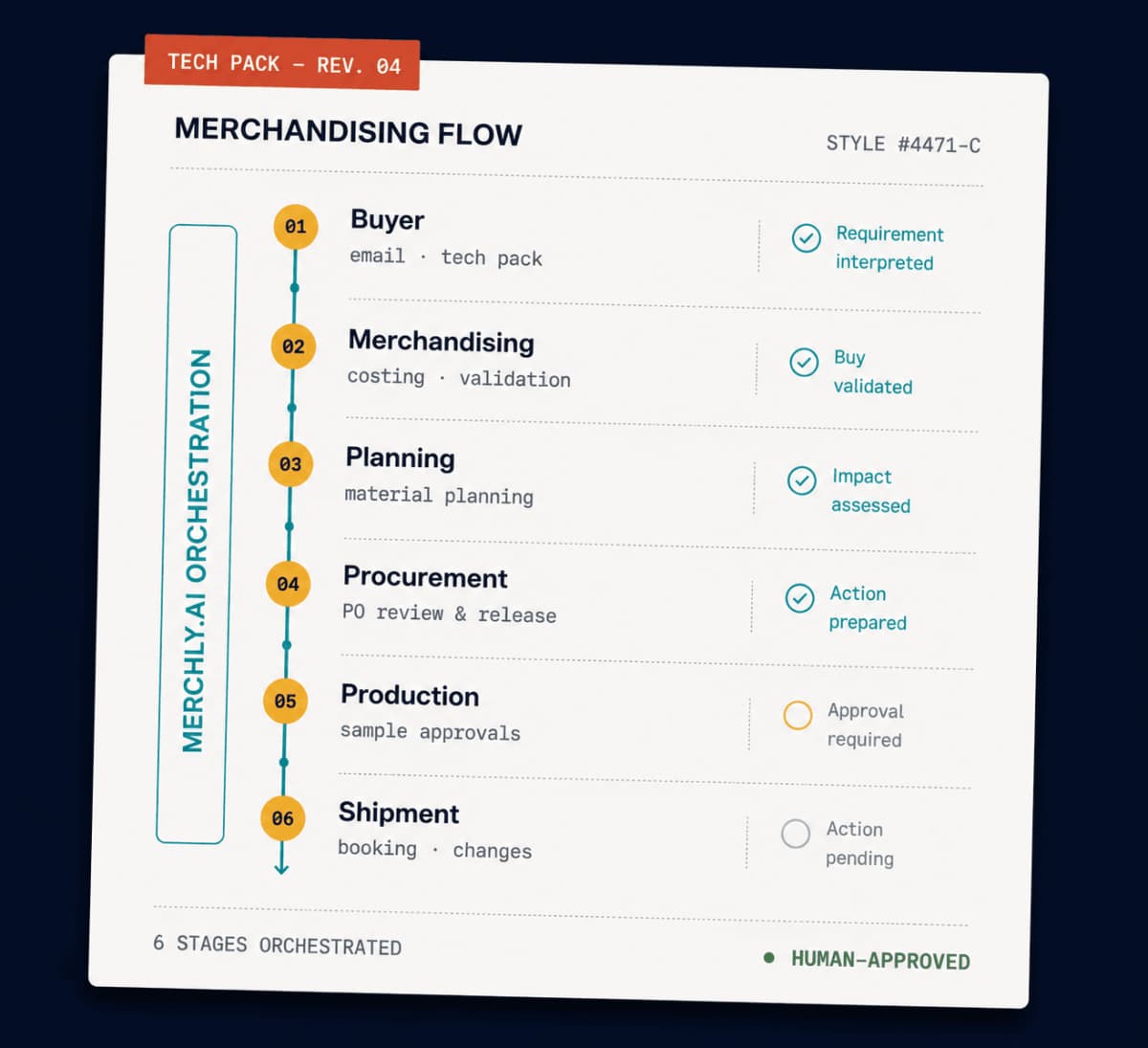
AI Across Every Stage of Merchandising Execution

Buyer Communication
Understands buyer emails, specifications, tech packs, and supporting documents.

Buyer Validation
Identifies missing or inconsistent information before execution begins.

Change Impact Assessment
Assesses how buyer changes affect planning, procurement, production, and delivery.

Material Planning Support
Supports material planning, procurement recommendations, and purchase decisions.

Approval & Coordination
Surfaces approvals, next actions, and stakeholder dependencies.

Operational Visibility
Tracks merchandising workloads, bottlenecks, turnaround times, and performance.
Proven Enterprise Transformation
Transforming Merchandising Execution for One of South Asia's Largest Apparel Manufacturers
Increase in Time to Market
Decrease in Cost to Serve
Increase in NPS Score
MerchLY.AI
Ready to Transform Apparel Merchandising Execution?
AI in apparel merchandising uses artificial intelligence to help merchandising teams interpret buyer requirements, understand documents, identify changes, validate information, assess downstream impact, and coordinate actions across the merchandising lifecycle.
For apparel manufacturers, this can reduce the manual knowledge work that happens between buyer communication and execution across planning, procurement, production, and shipment.
MerchLY.AI is an AI-powered merchandising execution solution for apparel manufacturers. It works alongside merchandising teams to understand buyer requirements, identify changes, validate information, assess their impact, and prepare the next best action.
Rather than replacing existing enterprise systems, MerchLY.AI works with the systems and processes already used to run apparel operations.
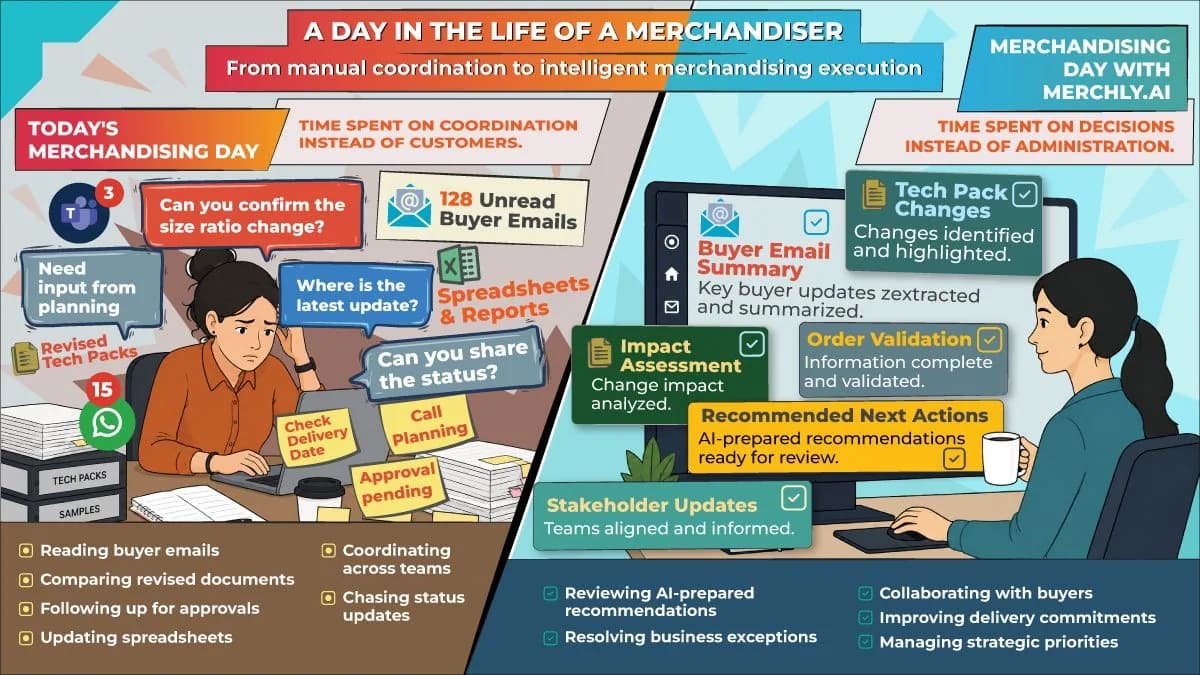
AI can improve apparel merchandising by reducing the time teams spend reading and interpreting buyer communications, comparing revised documents, validating information, coordinating approvals, assessing changes, and following up across teams.
This allows merchandisers to spend more time on buyer relationships, business exceptions, delivery commitments, and decisions that require their experience and judgment.
Yes. MerchLY.AI is designed to work with the unstructured and semi-structured information commonly used in apparel merchandising, including buyer emails, tech packs, PDFs, spreadsheets, and supporting documents.
AI can extract relevant information, understand context, identify changes, and prepare information for merchandiser review.
Yes. AI can compare revised information and help identify changes across specifications, quantities, colourways, materials, dates, and other buyer requirements.
MerchLY.AI can surface those changes for review and help teams understand their potential impact before actions are taken downstream.
No. MerchLY.AI is designed to work alongside ERP, PLM, SAP, workflow platforms, and other enterprise applications.
These systems continue to serve as systems of record. MerchLY.AI addresses the knowledge work around them by interpreting information, understanding context, supporting decisions, and coordinating actions across systems and teams.
No. MerchLY.AI is designed to augment merchandising teams, not replace them.
AI can take on repetitive interpretation, validation, comparison, coordination, and information-preparation activities. Merchandisers remain responsible for business judgment, buyer relationships, exceptions, approvals, and consequential decisions.
Start by identifying merchandising activities that involve high volumes of manual interpretation, validation, coordination, or exception handling. Examples include buyer communication, tech pack changes, buy validation, change impact assessment, material planning, and approval coordination.
LOWCODEMINDS can help identify and prioritize these opportunities through an Apparel AI Discovery Workshop, allowing manufacturers to start with a focused use case before expanding AI across the merchandising value chain.
LOWCODEMINDS is a global leader in AI-led enterprise process orchestration and Knowledge Work Automation, transforming fragmented workflows into orchestrated, AI-driven decision systems that help enterprises modernize and scale business operations. Recognized as a Top Player and Contender in the ISG Provider Lens® Intelligent Automation Services 2025 (U.S.) study, the company is at the forefront of next generation automation and enterprise transformation.
LOWCODEMINDS helps enterprises transform knowledge intensive and compliance heavy enterprise value chains through trusted, governed, and scalable AI automation that delivers measurable operational and financial outcomes. Powered by App Labs, its dedicated innovation division, the company has developed 7+ Enterprise Value Chain Frameworks, 20+ reusable Agentic AI Accelerators, and 18+ enterprise ready solutions across industries including BFSI, Legal, Manufacturing, Retail, CCM, and Telecommunications.

Headquarters:
8, The Green Ste B, Dover, DE 19901.
[email protected]
(276) 451-3607
2026
LOWCODEMINDS | Privacy Policy