Agentic AI in Appian: AI Workflow Automation

Agentic AI in Appian: How AI Agents Are Transforming Enterprise Workflow Automation
Most enterprise AI initiatives today are still operating at the assistant layer.
Organizations are experimenting with copilots, chat interfaces, and AI-generated summaries, but very few have successfully operationalized AI inside core business workflows. In many enterprise Appian engagements, the real challenge is not deploying AI models. It is integrating AI into governed operational processes where decisions, escalations, compliance, and accountability still matter.
This is where Agentic AI changes the conversation.
Instead of functioning as isolated productivity tools, AI agents can operate directly inside enterprise workflows, interact with enterprise systems, evaluate business context, trigger actions, and collaborate with human users. The shift is significant because enterprises are no longer looking for AI that simply answers questions. They want AI that can help move work forward safely within operational boundaries.
Appian’s approach to Agentic AI is especially important because it combines AI agents, workflow orchestration, enterprise governance, contextual data access, and low-code automation within a unified platform. Rather than positioning AI as a disconnected layer, Appian embeds intelligence directly into business processes.
What Is Agentic AI in Appian and How Does It Work?
Agentic AI refers to AI systems that can reason, make decisions, and take actions across multi-step workflows.
Unlike traditional AI assistants that respond to prompts in isolation, AI agents can operate with context, objectives, and operational awareness. They can analyze information, interpret documents, evaluate business rules, recommend next actions, and participate in workflow execution.
In Appian, AI agents operate inside the process layer rather than outside it.
This distinction matters because enterprise workflows require governance. Organizations need visibility into what the AI is doing, what information it can access, what actions it can trigger, and when human intervention is required.
Instead of employees switching between disconnected systems and standalone AI tools, Appian AI agents become embedded participants inside enterprise workflows. The process model determines when the AI should act, what data it can access, what business rules apply, and when escalation or approval is necessary.
Appian describes AI agents as configurable objects capable of understanding goals, interacting with enterprise systems through reusable tools, and helping automate goal-driven business processes.
The result is a more operational form of enterprise AI.
Why Traditional Workflow Automation Is No Longer Enough
Traditional workflow automation has delivered enormous value to enterprises over the last decade.
Many enterprises already use Appian for enterprise automation across workflow orchestration, case management, operational modernization, and intelligent automation initiatives. Organizations have successfully automated repetitive operational tasks such as approvals, notifications, routing, validations, and data movement between systems. These rule-based workflows work extremely well when processes are predictable and outcomes are clearly defined.
However, in many enterprise environments, operational workflows are no longer entirely structured.
Customer interactions involve context-heavy conversations. Claims processing includes large volumes of documents and exceptions. Compliance workflows often require interpretation rather than simple validation. Service operations constantly deal with changing business conditions, fragmented information, and operational ambiguity.
This is where traditional automation begins to struggle.
In many Appian implementations, the limitation is not the workflow engine itself. The challenge is handling the judgment-heavy and information-intensive steps that sit between structured process stages.
This is where Agentic AI creates value.
AI agents can analyze context, understand intent, interpret documents, recommend actions, summarize operational history, detect anomalies, and support decision-making inside enterprise workflows. This makes Agentic AI especially valuable for intelligent workflow automation, AI-assisted decision-making, enterprise case management, and AI-driven business process management.
The future of enterprise automation is not AI replacing workflows.
It is AI participating inside orchestrated workflows with governance, escalation paths, and human oversight built directly into the process layer.
How Does Agentic AI Work Inside Appian Workflow Automation?
One of Appian’s biggest differentiators is that AI agents operate within governed enterprise workflows. This enables organizations to operationalize AI-powered workflow automation without sacrificing auditability, visibility, or operational control.
Rather than functioning as isolated AI tools, Appian agents are embedded into:
- Process models
- Appian Data Fabric
- Case management workflows
- Business rules
- Human approval paths
- Enterprise audit trails
This creates a structured operational environment where AI can safely participate in enterprise business processes.
Organizations implementing enterprise AI workflows should also prioritize scalable Appian architecture best practices to ensure performance, governance, and long-term maintainability as AI orchestration expands across business functions.
How an AI Agent Operates Inside an Appian Workflow
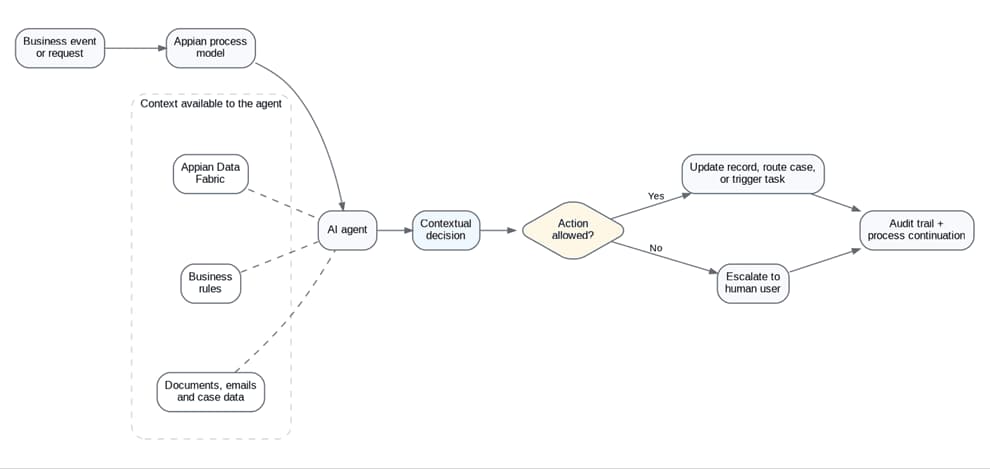
In a typical Appian workflow, the process begins when a customer request, operational case, service event, or business trigger enters the system. The Appian process model orchestrates the workflow and passes relevant context to the AI agent.
Instead of operating with isolated prompts, the AI agent works with enterprise records, documents, business rules, historical workflow data, and contextual operational information.
The agent evaluates the request using Appian Data Fabric and determines the next best action based on governance rules and workflow conditions. Depending on confidence levels and policy requirements, the process may allow the AI to complete actions autonomously, recommend next steps to users, or escalate decisions for human review.
This architecture is important because it keeps AI decisions connected to enterprise workflows, governance controls, and operational auditability. It also positions Appian as a strong platform for organizations looking to build context-aware AI agents inside low-code business process management environments.
Traditional Workflow Automation vs Agentic AI in Appian
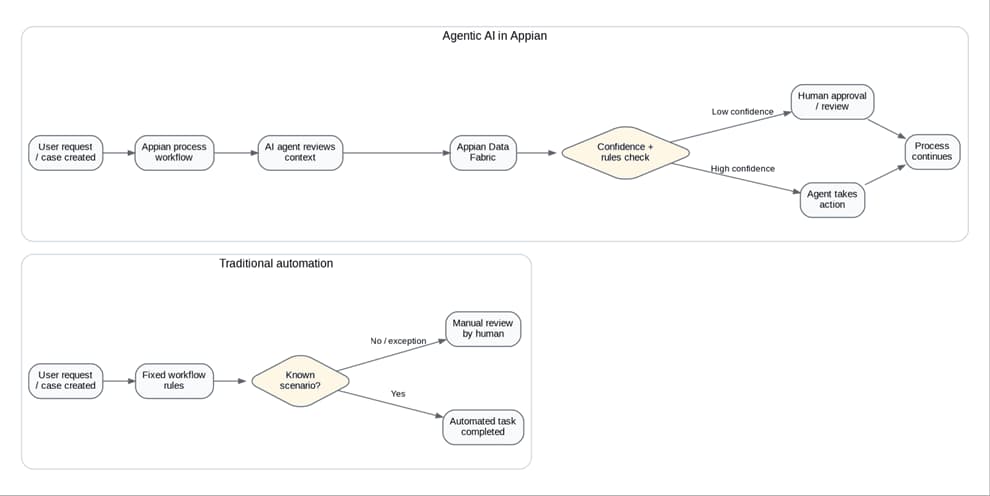
Traditional workflow automation and Agentic AI solve very different categories of enterprise problems.
Traditional automation is highly effective when workflows are structured, inputs are predictable, and outcomes follow fixed business rules. This is why organizations successfully use workflow automation for invoice routing, standard approvals, form validations, and repetitive operational activities.
However, enterprise workflows are increasingly driven by ambiguity, exceptions, unstructured information, and contextual decision-making.
This is where AI agents become valuable operational participants.
Instead of relying entirely on hardcoded workflow paths, AI agents can interpret information dynamically, evaluate context, identify missing information, classify requests, and recommend next actions while still operating within enterprise governance boundaries.
AI agents can summarize case histories, interpret uploaded documents, classify requests dynamically, recommend next-best actions, detect anomalies, trigger workflows based on business context, and collaborate with human users. This allows enterprises to move from static workflow automation toward intelligent process automation powered by enterprise AI agents.
The most important difference is adaptability.
Traditional automation executes predefined logic.
Agentic AI supports operational reasoning within governed workflows.
Why Appian Data Fabric Matters for AI Agents and Intelligent Automation
One of the biggest barriers to enterprise AI adoption is fragmented data.
AI systems are only effective when they can access relevant, trusted, and contextual business information. Many organizations struggle because operational data is spread across disconnected applications, systems, documents, and workflows.
Appian positions Data Fabric as a foundational layer that gives AI agents unified access to enterprise information without requiring extensive data duplication.
This allows AI agents to work with:
- Customer records
- Operational data
- Workflow history
- Emails and documents
- Compliance information
- Enterprise systems
- Third-party applications
Because the AI agent operates inside Appian’s governed environment, organizations maintain visibility into every AI-driven operational decision. This is one of the reasons Appian is increasingly associated with enterprise AI orchestration, intelligent workflow automation, and governed AI workflow management.
Organizations can track:
- What data the agent accessed
- What actions it performed
- What recommendations were generated
- Which workflow triggered the action
- When human escalation occurred
This level of governance is essential for regulated industries such as banking, insurance, healthcare, telecommunications, and public sector operations.
The real enterprise value of Agentic AI is not unrestricted autonomy.
It is governed operational intelligence.
What Makes Appian Different for Enterprise AI Automation?
Many organizations today are experimenting with standalone AI assistants and disconnected AI productivity tools. While these tools can improve individual productivity, they often struggle to scale across enterprise operations because they lack workflow orchestration, governance, auditability, and operational context.
In practice, most enterprise AI pilots fail not because the AI model is weak, but because the AI is implemented outside operational systems.
This is where Appian differentiates itself.
Appian combines AI agents, workflow orchestration, low-code automation, Data Fabric, case management, and human-in-the-loop governance within a unified operational platform.
Appian’s strength in Agentic AI orchestration comes from its ability to combine workflow automation, governance, enterprise data access, and AI agents within a unified operational layer.
This allows organizations to operationalize AI directly inside enterprise workflows rather than treating AI as a separate technology layer.
From an implementation perspective, this is a critical distinction. Enterprises need AI systems that can participate safely inside regulated operational environments where approvals, escalations, compliance requirements, and auditability are essential.
The organizations seeing long-term success with Agentic AI are not treating AI as an isolated assistant layer.
They are embedding AI directly into governed business processes with operational visibility and process accountability built in from the start.
Key Benefits of Appian AI Agents for Enterprise Automation
Faster Workflow Execution
AI agents reduce manual bottlenecks by handling repetitive, information-heavy tasks such as summarization, classification, document interpretation, and intelligent routing.
This helps organizations accelerate:
- Customer service resolution
- Claims handling
- Loan onboarding
- Vendor management
- IT incident response
Improved Operational Consistency
Enterprise operations often vary across teams and departments due to inconsistent human interpretation.
AI agents help standardize how operational information is evaluated and how routine actions are handled across workflows.
Human-in-the-Loop Governance
One of Appian’s biggest strengths is selective autonomy.
Organizations can define:
- Which actions agents can complete automatically
- Which workflows require approval
- What confidence thresholds trigger escalation
- How exceptions should be handled
This creates a practical balance between operational automation and enterprise oversight.
Organizations scaling enterprise AI operations should also establish strong Appian CoE best practices to maintain governance, delivery consistency, and operational accountability across teams.
Better Use of Enterprise Knowledge
AI agents can work across structured and unstructured enterprise information rather than relying only on databases and forms.
This includes:
- Documents
- Emails
- Workflow history
- Historical case records
- Policy content
- Operational context
This allows enterprises to make more informed operational decisions.
Scalable Enterprise AI Adoption
Because Appian combines low-code development with AI orchestration and workflow automation, organizations can operationalize enterprise AI significantly faster than building disconnected AI systems independently.
Enterprises looking to expand AI adoption across departments should also focus on scaling Appian across the enterprise to move from isolated automation initiatives toward organization-wide operational transformation.
Enterprise Use Cases for AI Agents in Appian
One of the biggest advantages of Appian Agentic AI is that organizations can apply AI agents across multiple operational domains without creating isolated AI systems for every business function.
Since Appian combines workflow orchestration, enterprise data access, governance controls, and intelligent automation capabilities, AI agents can be embedded directly into operational workflows at scale.
Customer Service and AI-Driven Case Management
AI agents can summarize customer interactions, recommend next actions, classify requests dynamically, identify priority escalations, and support service teams with contextual insights.
This helps organizations improve response times, reduce handling effort, and create more consistent customer experiences.
Insurance Claims Processing
Insurance workflows involve large volumes of documents, validations, approvals, and exceptions.
AI agents can extract claim details, compare documents against policy requirements, identify missing information, recommend approval paths, and escalate suspicious claims for review.
This helps insurers improve claims processing efficiency while maintaining governance and compliance.
Financial Services Onboarding
Banking and financial institutions often manage document-heavy onboarding and compliance workflows.
Organizations using Appian for financial services are increasingly embedding AI agents into compliance operations, customer onboarding, and risk management workflows to improve operational efficiency while maintaining governance.
Appian AI agents can validate customer documents, detect incomplete submissions, identify compliance risks, prioritize high-risk cases, and trigger verification workflows.
This helps reduce onboarding delays and improves operational efficiency.
Procurement and Vendor Management
Procurement teams manage contracts, supplier documentation, compliance requirements, and approval chains across multiple systems.
AI agents can analyze supplier documents, summarize contract terms, detect compliance gaps, trigger approval workflows, and recommend next actions based on operational context.
IT Service Management
AI agents can support enterprise IT operations by triaging support tickets, suggesting resolutions, updating operational records, escalating incidents, and coordinating workflow actions across service processes.
This improves response times while reducing operational overhead.
Why AI Agent Governance Matters in Enterprise Appian Workflows
One of the biggest concerns enterprises have about AI adoption is control.
Organizations need visibility into:
- What decisions the AI makes
- What systems the AI accesses
- Whether actions follow policy
- When human intervention occurs
- How operational decisions are logged
In regulated industries, governance is not optional. It is operationally critical.
This is where Appian’s process-centric architecture becomes strategically important.
Instead of giving AI unrestricted autonomy, enterprises can design workflows that define action boundaries, require approvals for sensitive operations, escalate uncertain outcomes, maintain audit trails, and track AI-generated decisions.
In many enterprise automation programs, the real value of Agentic AI is not autonomous decision-making.
It is governed operational intelligence.
The future of enterprise AI is not autonomous AI systems operating outside governance.
It is AI embedded inside orchestrated business processes where people, workflows, and AI agents operate together with visibility and accountability.
Appian Agent Studio and the Rise of Low-Code AI Automation
Appian has introduced Agent Studio to help organizations build, govern, and orchestrate AI agents within the Appian ecosystem.
This is important because many enterprises struggle with the gap between AI experimentation and operational deployment.
Agent Studio helps bridge that gap by enabling:
- AI agent configuration
- Workflow integration
- Tool orchestration
- Governance management
- Low-code AI implementation
This approach empowers business technologists, process analysts, automation teams, and low-code developers to operationalize AI without treating it as an isolated data science initiative.
Instead, organizations can align AI directly with operational business workflows.
How Appian AI Copilot Supports Enterprise AI Workflows
In addition to workflow-based AI agents, Appian AI Copilot supports enterprise users with contextual AI assistance.
Appian AI Copilot capabilities include:
- Asking questions about enterprise record data
- Generating operational reports
- Summarizing workflow information
- Chatting with enterprise documents
- Supporting Process HQ insights
This creates a broader enterprise AI ecosystem where:
- AI agents automate workflows
- AI copilots support employees
- Process orchestration governs operations
- Human oversight maintains control
Together, these capabilities help organizations operationalize AI across business functions while building scalable enterprise AI workflows that combine automation, governance, contextual intelligence, and low-code orchestration.
Recent Appian platform updates continue accelerating enterprise AI adoption with deeper investments in AI capabilities, smart search, intelligent automation, and AI-first operational execution.
What Enterprises Should Consider Before Implementing AI Agents in Appian
Successful AI adoption requires more than deploying a model.
Organizations need to think carefully about workflow orchestration, governance design, escalation logic, operational ownership, and process accountability before introducing AI agents into business-critical environments.
Enterprises evaluating AI-driven automation initiatives should also understand Appian implementation best practices to avoid governance, scalability, and operational adoption challenges during rollout.
Which Workflows Are Best Suited for AI Agents?
The best starting points are:
- Repetitive operational tasks
- Information-heavy workflows
- High-volume processes
- Multi-step reviews
- Case-driven operations
Where Should Humans Remain Involved?
Not every operational decision should be autonomous.
Organizations must identify:
- Sensitive approvals
- Compliance-heavy workflows
- Judgment-intensive decisions
- High-risk operational scenarios
- Escalation requirements
The Future of Enterprise Workflow Automation Is Agentic AI
The future of enterprise workflow automation is not fully autonomous AI replacing human operations.
It is governed, process-centric AI collaborating with people inside orchestrated workflows.
Appian’s approach to Agentic AI reflects this shift by combining:
- AI agents
- Workflow orchestration
- Enterprise governance
- Human supervision
- Data Fabric
- Low-code automation
- Intelligent process management
This allows organizations to operationalize AI inside real enterprise workflows rather than deploying disconnected AI systems.
For enterprises exploring workflow modernization and AI transformation, the real question is no longer whether AI can assist operations.
The real question is: How can AI safely participate in operational decision-making while maintaining governance, transparency, process control, and enterprise accountability?
That is where Agentic AI in Appian becomes strategically important.
Organizations are moving beyond static workflows toward intelligent operational systems capable of interpreting context, supporting decisions, and automating multi-step business processes.
Appian’s strength lies in combining AI agents with workflow orchestration, governance, enterprise data management, and low-code automation.
Instead of treating AI as a separate technology layer, Appian embeds intelligence directly into operational workflows.
For enterprises looking to modernize operations with governed AI automation, Agentic AI in Appian provides a scalable framework for operationalizing enterprise AI responsibly.
At LOWCODEMINDS, we help enterprises design and implement AI-powered Appian solutions that combine intelligent workflow automation, governance, process orchestration, and operational scalability.
To learn how enterprises are implementing scalable Appian modernization, workflow orchestration, and AI-powered automation strategies, explore our Appian consulting and intelligent automation services.
Agentic AI in Appian refers to AI-powered agents that can reason, make decisions, and take actions inside enterprise workflows using Appian’s process orchestration, governance, and Data Fabric capabilities.
Traditional workflow automation follows predefined rules and fixed logic. Agentic AI can interpret context, analyze information, adapt actions dynamically, and support operational reasoning while still operating within governed business processes.
Appian Data Fabric gives AI agents unified access to enterprise data, operational records, workflow history, documents, and contextual business information required for intelligent decision-making.
Yes, but autonomy can be selectively governed. Organizations can define approval workflows, escalation rules, confidence thresholds, and human review requirements to maintain operational control.
Industries with complex workflows and governance requirements benefit significantly, including:
- Banking and financial services
- Insurance
- Healthcare
- Telecommunications
- Government
- Enterprise IT operations
About the Author

Vibha Sharma
Vibha Sharma brings over 12 years of experience in Intelligent Automation, with deep expertise in Appian BPM implementation across enterprise environments. She has led the design and development of scalable applications across banking, financial services, advisory, legal, regulatory, healthcare, and investment sectors.
LOWCODEMINDS is a global leader in AI-led enterprise process orchestration and Knowledge Work Automation, transforming fragmented workflows into orchestrated, AI-driven decision systems that help enterprises modernize and scale business operations. Recognized as a Top Player and Contender in the ISG Provider Lens® Intelligent Automation Services 2025 (U.S.) study, the company is at the forefront of next generation automation and enterprise transformation.
LOWCODEMINDS helps enterprises transform knowledge intensive and compliance heavy enterprise value chains through trusted, governed, and scalable AI automation that delivers measurable operational and financial outcomes. Powered by App Labs, its dedicated innovation division, the company has developed 7+ Enterprise Value Chain Frameworks, 20+ reusable Agentic AI Accelerators, and 18+ enterprise ready solutions across industries including BFSI, Legal, Manufacturing, Retail, CCM, and Telecommunications.

Headquarters:
8, The Green Ste B, Dover, DE 19901.
[email protected]
(276) 451-3607
2026
LOWCODEMINDS | Privacy Policy