AI for Transaction Fraud Monitoring | LOWCODEMINDS

AI for Transaction Fraud Monitoring: How Financial Institutions Can Improve Fraud Detection
Fraud monitoring has always involved a trade-off. Financial institutions need controls strong enough to identify suspicious transactions early, but those controls also need to avoid holding up genuine customers or leaving fraud teams with an unmanageable number of alerts to investigate.
That balance is getting harder to maintain.
Transaction volumes are growing, customers are using more channels, and the patterns associated with fraud keep changing. A transaction may look perfectly reasonable when viewed on its own and become suspicious only when it is compared with the customer's normal behaviour or with a sequence of activity that took place before it.
This is one reason financial institutions are looking at AI for transaction fraud monitoring.
The useful question, however, is not how many more transactions AI can analyse. Financial institutions already monitor transactions at scale. The bigger issue is whether they can identify meaningful risk early enough, separate it from legitimate activity and give fraud analysts enough context to investigate it quickly.
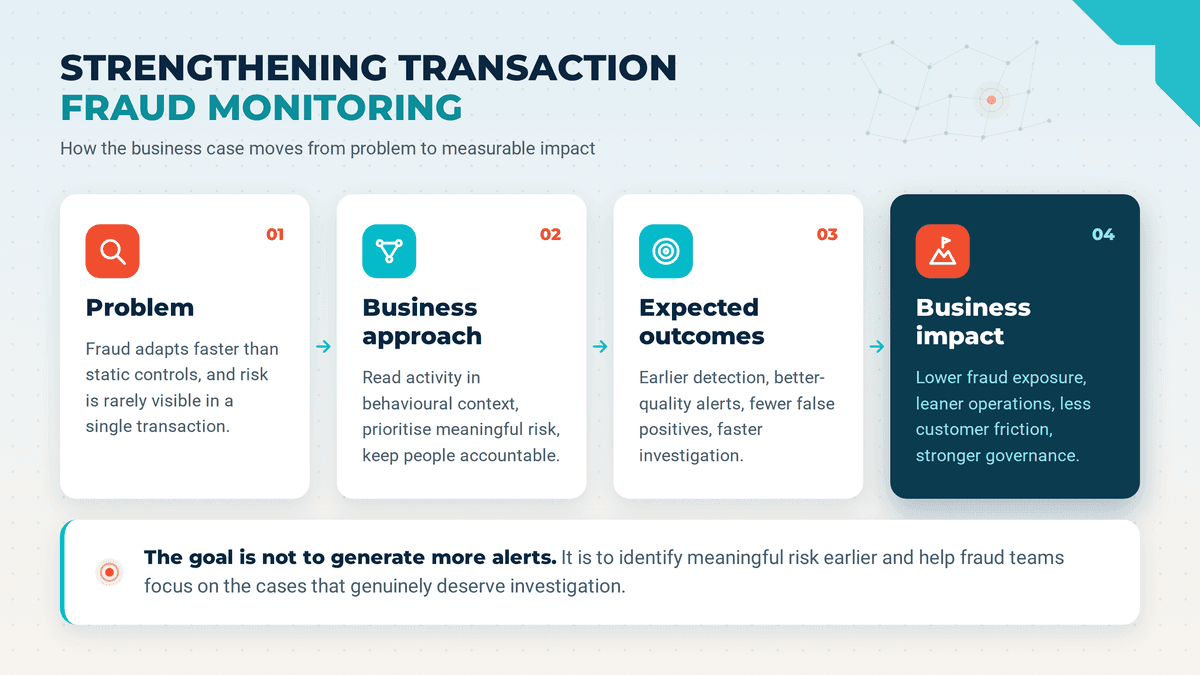
Why Traditional Fraud Monitoring Is Finding It Harder to Keep Up
Most financial institutions are not starting from scratch. They already have rules, thresholds and established fraud controls.
But those controls operate in an environment that keeps moving.
Customer behaviour changes. New payment channels are introduced. Transaction volumes increase. Fraud techniques adapt around controls that are already in place. A rule that worked well when it was introduced can gradually start producing more noise or miss patterns it was never designed to recognise.
There is another problem. Suspicious activity is rarely obvious from one transaction alone.
A payment to a new beneficiary may be legitimate. A sudden increase in transaction value may also have a perfectly reasonable explanation. But when several changes happen together, perhaps across different transactions or channels, the picture can look very different.
Traditional rules can still play an important role in fraud monitoring. The challenge is giving those rules more context.
What Does AI Add to Transaction Fraud Monitoring?
AI-based transaction fraud monitoring can analyse activity against a customer's previous behaviour and look for patterns across transactions, accounts, time periods and channels.
That changes the basis on which activity can be assessed.
Instead of treating every customer against broadly similar thresholds, a financial institution can begin to distinguish between something that is unusual across its customer base and something that is unusual for this particular customer.
Consider a customer making a large international transfer. The amount alone tells the fraud team very little. If the customer regularly makes similar transfers to the same beneficiary, there may be nothing unusual about it.
If that same transfer follows an unusual login, involves a new beneficiary and is followed by several rapid transactions, those events together provide a very different context.
AI is useful here because it can help identify those relationships across large volumes of activity and bring the relevant signals together.
It does not mean every anomaly becomes a fraud case. Nor does it mean the model should make the final decision. It gives the fraud team a better starting point for deciding which activity deserves attention.
Five Areas Where AI Can Improve Fraud Monitoring
1. Understanding Normal Customer Behaviour
One of the limitations of relying heavily on fixed thresholds is that "normal" does not mean the same thing for every customer.
Behavioural baselining helps establish how an individual customer typically transacts and highlights meaningful departures from that pattern.
This distinction matters when financial institutions are trying to reduce false positives. An activity can be uncommon across the wider customer base without being suspicious for the individual carrying it out.
2. Finding Patterns Across Transactions
Some fraud patterns become visible only as a sequence.
Changes in transaction frequency, new counterparties, unusual transaction values or activity moving across channels may not be significant individually. Looked at together, they may warrant investigation.
Pattern and sequence analysis can help fraud teams identify these relationships without expecting an individual rule to capture the entire scenario.
3. Deciding Which Alerts Need Attention First
A fraud team does not benefit simply because its monitoring environment produces more alerts.
If analysts have to work through large volumes of low-value cases before reaching genuinely suspicious activity, the monitoring process is creating work rather than improving the response.
Risk-based prioritisation can help bring the cases with stronger or more consequential signals to the front of the queue.
The measure then becomes less about how many alerts were generated and more about whether the right cases reached analysts at the right time.
4. Giving Analysts More Context Before They Investigate
Fraud investigation often involves more work than reviewing the transaction that triggered an alert.
An analyst may need to look at previous transactions, understand the customer's normal behaviour, identify related activity and establish why the case was flagged in the first place.
When that information sits across different systems, a significant part of the investigation becomes information gathering.
AI can help assemble some of that context before or as the case reaches the analyst. That leaves the analyst with more time for the part that requires experience and judgment.
There is an important Knowledge Work Automation element here.
Fraud analysts are not simply processing transactions. They are interpreting information, applying policy, weighing context and making decisions. Automating the work around those decisions, without attempting to automate judgment itself, is where AI can be particularly useful.
5. Making the Reason Behind an Alert Clear
An alert is much more useful when the analyst can see why it was raised.
Was there a departure from the customer's normal behaviour? Was there a sequence of unusual transactions? Did several risk signals appear together?
That reasoning also matters beyond the investigation itself. Financial institutions need decisions that can be reviewed internally and, where required, explained through their AI governance and audit processes.
Explainability therefore needs to be part of the monitoring approach from the beginning rather than something added later.
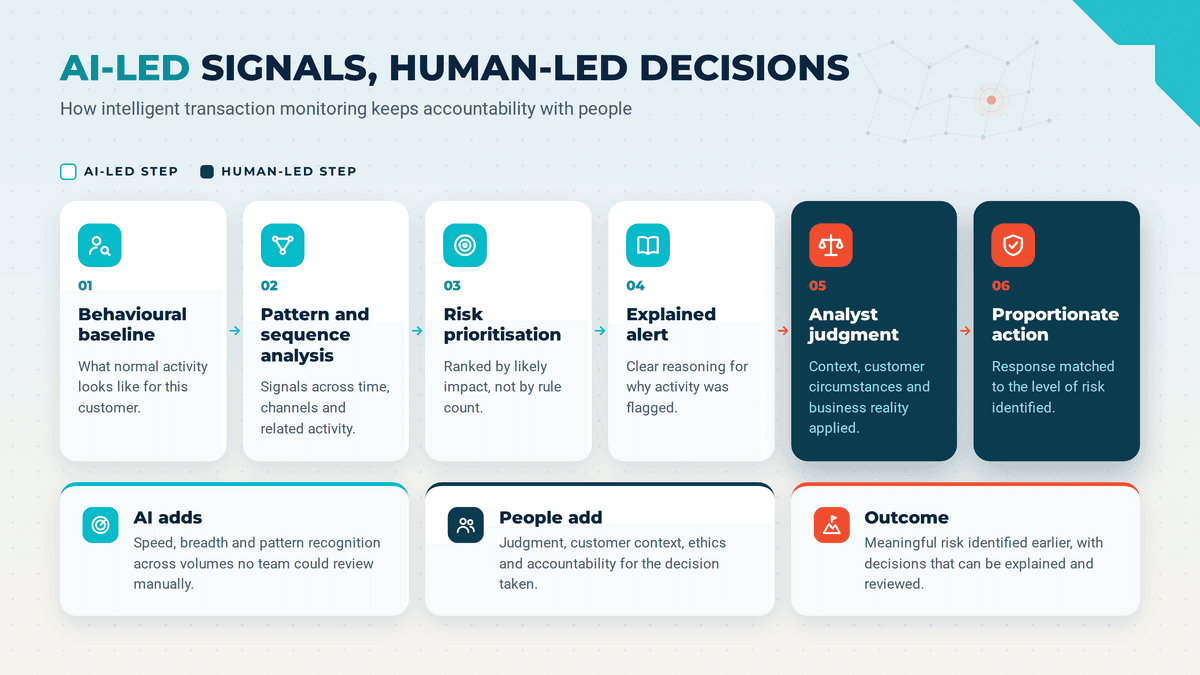
AI-Led Signals, Human-Led Decisions
There is a tendency to frame AI in fraud monitoring around how much of the decision can be automated. That is not necessarily the most useful way to look at it.
AI is well suited to working through large volumes of transaction data, recognising patterns, comparing behaviour and bringing potentially relevant activity to the surface.
People bring something different. An experienced fraud analyst can understand customer circumstances, interpret an ambiguous situation, apply policy and commercial context, and decide whether an intervention is justified.
The two roles work better together. AI can help with behavioural baselining, pattern and sequence analysis, risk prioritisation and assembling the context behind an alert. The analyst can then use that information to investigate the case and determine what happens next.
Can AI Help Reduce False Positives in Fraud Detection?
This is likely to be one of the first questions for any fraud team considering a more intelligent monitoring approach.
False positives consume analyst capacity and can also create unnecessary disruption for genuine customers. The problem often comes down to context.
A rule can tell you that something unusual happened. It may be less capable of telling you whether that unusual activity makes sense for the customer involved.
Behavioural analytics adds that context. By looking at a transaction against the customer's established behaviour and related activity over time, fraud teams have more information with which to separate potentially suspicious activity from legitimate exceptions.
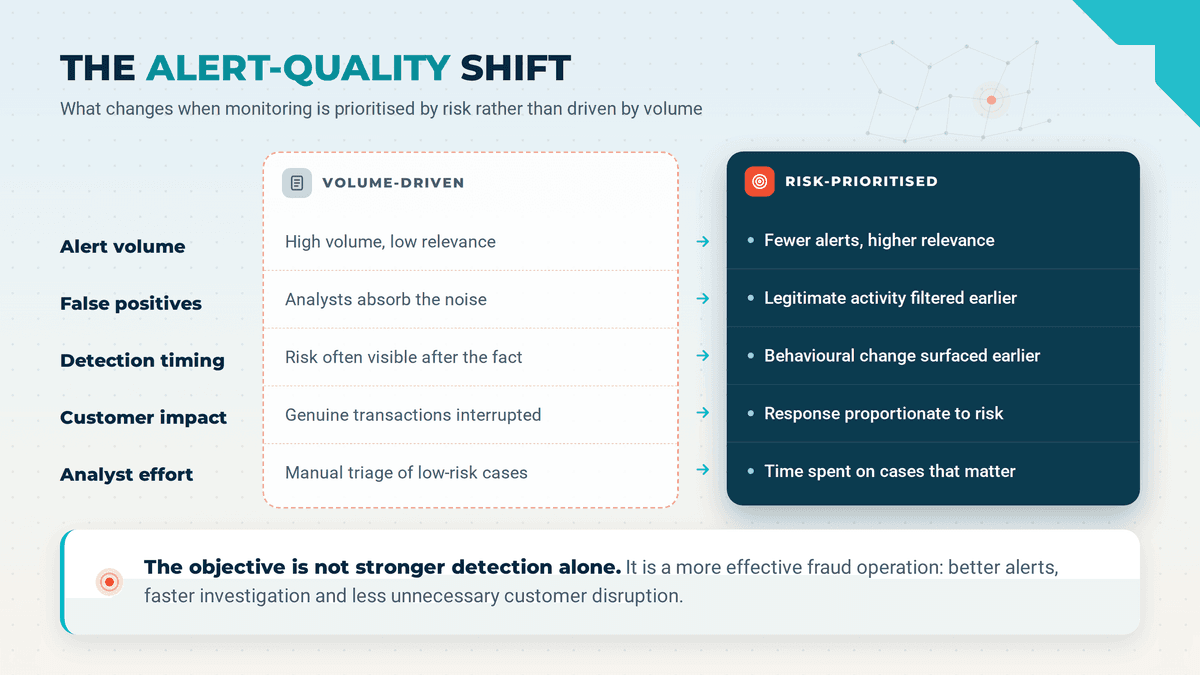
The objective should not be to eliminate alerts. It should be to improve their quality.
What Changes When Alert Quality Improves?
The effect is felt across the fraud operation.
Suspicious activity can be identified earlier because changes in behaviour are being considered alongside individual transaction rules.
Investigations can move faster when analysts receive the context behind an alert rather than having to reconstruct it themselves.
Legitimate customers are less likely to face unnecessary intervention when the response can be proportionate to the level of risk.
And experienced fraud analysts spend less time clearing routine cases and more time on investigations where their judgment actually matters.
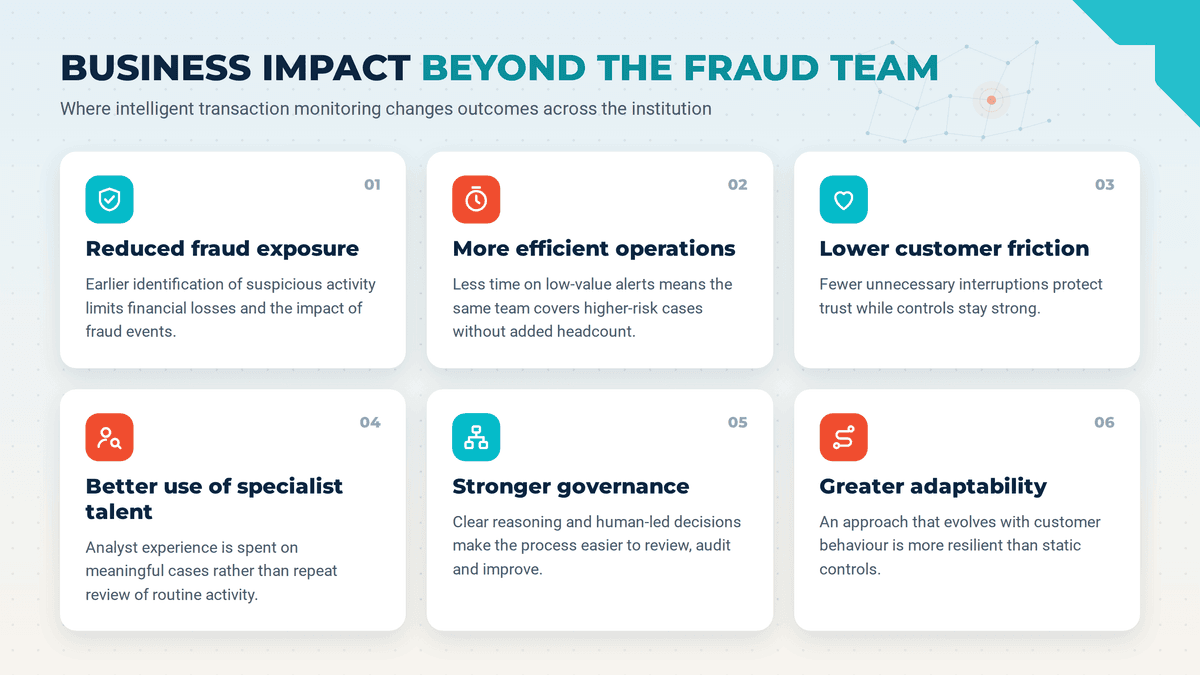
The Business Case Goes Beyond Fraud Detection
It is easy to measure a fraud monitoring initiative only in terms of detection. Financial institutions should look more broadly.
There is the direct financial exposure associated with fraud, but there is also the cost of investigating alerts, the amount of specialist capacity consumed by false positives and the effect that unnecessary interventions have on customers.
Governance matters too. If an institution cannot easily establish why an alert was raised or how a decision was reached, improving model performance alone does not solve the whole problem.
A more useful business case therefore looks across fraud exposure, investigation effort, customer friction, operational capacity and governance.
When Should a Financial Institution Reassess Its Fraud Monitoring?
A major fraud incident should not be the first indication that the monitoring approach needs attention.
There are usually operational signs much earlier.
If alert volumes keep rising without improving outcomes, analysts are spending a large proportion of their time clearing false positives, or genuine customers are regularly being interrupted, the monitoring environment deserves another look.
The same applies when analysts have to manually gather information from several places for every investigation, suspicious patterns are difficult to recognise across channels, or controls need continual adjustment to keep up with changing behaviour.
None of these automatically means the existing fraud monitoring platform needs to be replaced.
The more useful question is where the current process is struggling.
That could be detection. It could be alert prioritisation. It could be the information available to investigators. Or it could be the workflow that connects an alert to investigation, decision and action.
Where Should Financial Institutions Start With AI for Fraud Monitoring?
Before selecting another model or adding another control, it is worth looking at the current fraud-monitoring process end to end.
Start with what the fraud team experiences every day:
- How many alerts turn out to be legitimate?
- How much time does an analyst spend gathering information before they can actually investigate a case?
- How many systems do they typically access?
- Which types of alerts repeatedly result in unnecessary customer intervention?
- Where are suspicious patterns currently difficult to identify?
- Once an investigation is complete, can the institution clearly establish why the case was flagged and how the decision was made?
The answers help identify whether the problem sits in detection, prioritisation, investigation, workflow or governance.
That matters because applying AI to the wrong part of the process can simply create another layer of technology without changing the outcome.
From More Alerts to Better Fraud Decisions
The case for AI in transaction fraud monitoring is not really about processing more transactions. Financial institutions already do that.
It is about making better use of what they know about those transactions.
When behavioural context, related activity and risk signals can be brought together earlier, fraud teams have a better chance of finding meaningful risk without treating every unusual transaction as suspicious.
And when analysts receive that context as part of the investigation rather than having to assemble it manually, AI starts to improve not only detection, but the way fraud work gets done.
That is ultimately the shift worth pursuing: fewer low-value alerts, better investigations and stronger decisions when genuine risk appears.
Assess Your Transaction Fraud Monitoring Approach
If false positives, growing alert volumes or investigation workloads are putting pressure on your fraud operations, the answer may not be another layer of controls.
LOWCODEMINDS works with enterprises to examine how AI, automation and workflow orchestration can improve knowledge-intensive processes. For fraud operations, that can begin with understanding where the current transaction monitoring and investigation process is creating unnecessary effort, customer friction or gaps in decision-making.
Write to us at [email protected] or you can schedule a consultation here.
AI-based transaction fraud monitoring uses techniques such as behavioural analytics and pattern recognition to assess transactions in context. It can compare activity with a customer's established behaviour and analyse related transactions across time, accounts or channels rather than relying only on fixed rules.
AI can help identify changes in customer behaviour, recognise patterns across multiple transactions, prioritise potentially higher-risk activity and provide fraud analysts with additional context for investigation.
Behavioural analysis can help distinguish between activity that is generally unusual and activity that is genuinely unusual for a particular customer. Looking at related transactions and behaviour over time provides additional context before an alert is prioritised for investigation.
No. AI can support pattern recognition, behavioural analysis, prioritisation and information gathering. Investigation still requires human judgment, particularly when customer circumstances, ambiguity or wider context need to be considered.
Rule-based fraud monitoring evaluates activity against predefined conditions or thresholds. AI can complement these controls by identifying behavioural changes, patterns and relationships that may not be captured by an individual rule.
Not necessarily. A financial institution can first assess where its existing monitoring process is struggling and determine whether AI can strengthen areas such as behavioural analysis, alert prioritisation, investigation or workflow orchestration.
Fraud analysts need to understand why activity was flagged and what information contributed to an assessment. Recording that reasoning also helps financial institutions review decisions through their governance and audit processes.
A practical starting point is the existing end-to-end fraud monitoring and investigation process. Reviewing false positives, alert quality, investigation time, analyst effort, customer interventions and governance requirements can help identify where AI is likely to create useful business value.
About the Author

Hirushiharan Thevendran
Hirushiharan Thevendran is a Senior Software Engineer specializing in AI-driven automation, with around five years of experience designing and developing enterprise applications. His expertise spans workflow automation and agentic AI, with a focus on solving complex business challenges.
A Claude Certified Architect, Hirushiharan focuses on building scalable applications and translating emerging AI technologies into practical solutions that improve business processes and operational efficiency.
LOWCODEMINDS is a global leader in AI-led enterprise process orchestration and Knowledge Work Automation, transforming fragmented workflows into orchestrated, AI-driven decision systems that help enterprises modernize and scale business operations. Recognized as a Top Player and Contender in the ISG Provider Lens® Intelligent Automation Services 2025 (U.S.) study, the company is at the forefront of next generation automation and enterprise transformation.
LOWCODEMINDS helps enterprises transform knowledge intensive and compliance heavy enterprise value chains through trusted, governed, and scalable AI automation that delivers measurable operational and financial outcomes. Powered by App Labs, its dedicated innovation division, the company has developed 7+ Enterprise Value Chain Frameworks, 20+ reusable Agentic AI Accelerators, and 18+ enterprise ready solutions across industries including BFSI, Legal, Manufacturing, Retail, CCM, and Telecommunications.

Headquarters:
8, The Green Ste B, Dover, DE 19901.
[email protected]
(276) 451-3607
2026
LOWCODEMINDS | Privacy Policy