Appian vs Power Platform vs OutSystems

Appian vs Power Platform vs OutSystems: Which Low-Code Platform Is Right For Enterprise Automation?
As enterprise digital transformation accelerates, low-code platforms have emerged as a critical enabler of speed, agility, and innovation. While traditional software development cycles are often too slow and expensive, low-code platforms allow business and IT teams to collaborate on application delivery with far less code and by reducing time to value and enabling rapid iteration. Among the top contenders in this space, Appian, Microsoft Power Platform, and OutSystems consistently dominate enterprise conversations. Each has strengths, unique philosophies, and optimal use cases. But which one is best suited for complex, enterprise-grade automation? This comprehensive guide compares these platforms across key criteria like architecture, automation capabilities, governance, scalability, pricing models, developer experience, and ecosystem maturity to help you make the most informed choice for your enterprise.
Platform Origins and Philosophy
Appian: Enterprise-First from Day One
Appian was built from the ground up for large enterprises needing secure, scalable process automation. Its core DNA lies in business process management (BPM), which remains deeply embedded in the platform. Appian is not just a low-code tool, it is a full-stack platform designed for end-to-end process orchestration, case management, AI integration, and enterprise-grade automation. Appian’s focus on modeling dynamic workflows, connecting to complex systems, and managing mission-critical workloads makes it particularly suited for regulated and high-stakes environments like banking, insurance, government, and healthcare.
Power Platform: Democratizing App Building within Microsoft Ecosystem
Microsoft Power Platform is composed of Power Apps, Power Automate, Power BI, and Power Virtual Agents, all deeply integrated into the Microsoft 365 ecosystem. It empowers business users and citizen developers to build apps, automate workflows, analyze data, and build chatbots using familiar tools and interfaces. Power Platform is ideal for enterprises already invested in Microsoft technologies like Azure, Dynamics 365, and Teams. While its low-code capabilities have grown stronger, it is primarily geared toward departmental or internal productivity use cases rather than large-scale cross-enterprise automation.
OutSystems: Full-Stack Development with High Customizability
OutSystems positions itself as a high-performance low-code platform with a strong focus on building custom web and mobile applications at scale. It offers a more developer-centric experience, with extensive extensibility and a visual IDE that supports full-stack logic and integration. OutSystems excels in front-end-heavy applications where pixel-perfect UI and customized user experiences are key. It is often chosen by enterprises seeking to replace legacy applications or deliver modern apps with complex user flows.
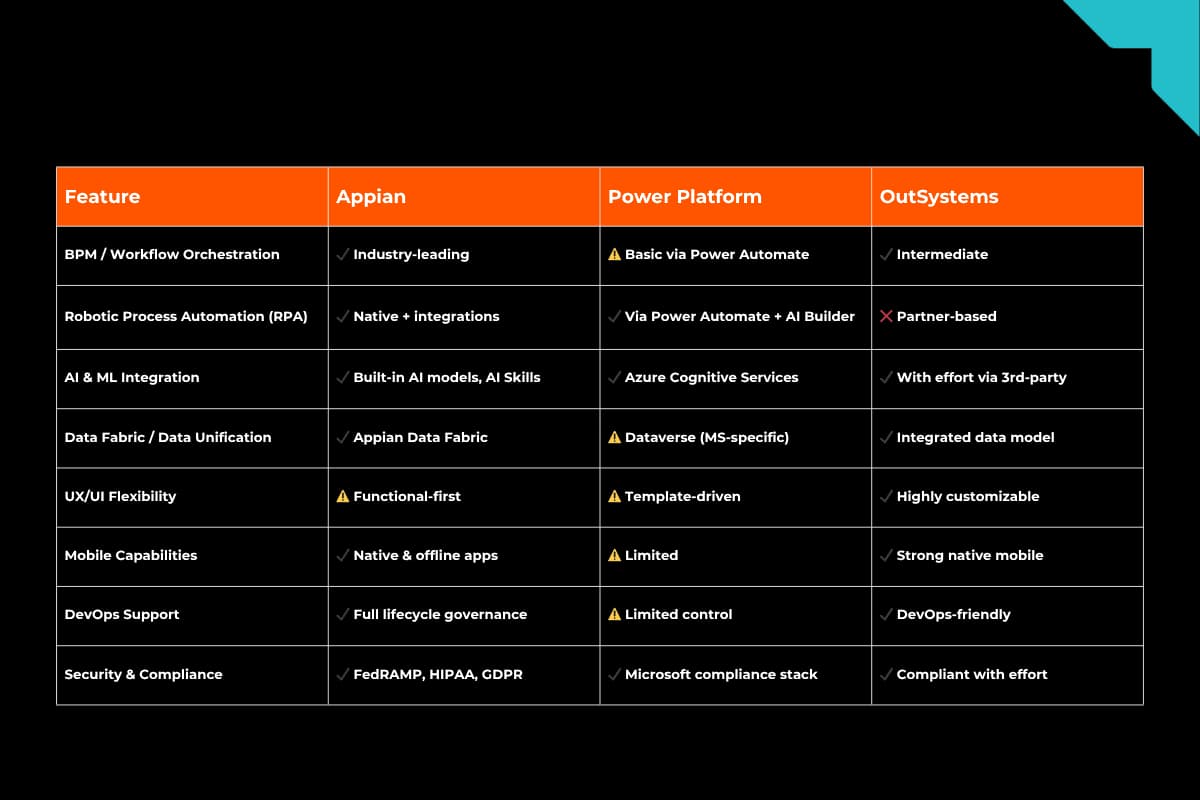
Core Capabilities Comparison
Automation Depth and Breadth
One of the most important factors when selecting a low-code platform for enterprise automation is how deep and wide its automation capabilities extend across the organization. It's not just about building simple workflows. True transformation happens when platforms can orchestrate complex processes across departments, systems, and data silos, all while adapting to business change without major rewrites.
Appian stands out for its deep-rooted process automation and case management strengths. It is designed from the ground up to handle complex, mission-critical workflows that involve multiple participants, exception handling, business rules, integrations, and regulatory controls. Appian combines workflow, RPA, data fabric, AI, and business rules into a unified platform, enabling end-to-end automation that touches both structured and unstructured work. This makes it particularly suitable for industries with high compliance demands, cross-functional processes, and long decision cycles.
Microsoft Power Platform offers broad automation capabilities across business units, especially within organizations already invested in the Microsoft ecosystem. Power Automate enables fast deployment of approval flows, task automations, and robotic process automation, while Power Apps simplifies front-end development. However, it may require significant configuration or custom connectors when automating processes that span non-Microsoft environments or when deeper orchestration logic is involved. Its breadth is strong, especially for productivity-focused use cases, but it may lack depth in areas like case management or cross-system orchestration without heavy development.
OutSystems offers solid breadth in automating both customer-facing and internal workflows, and its visual development tools help teams accelerate delivery. While it supports integrations and some process management capabilities, OutSystems has traditionally been stronger in app development than in enterprise-grade automation. Advanced process orchestration, exception management, and dynamic decision flows may require significant customization or external add-ons.
In short, Appian delivers high depth and full-lifecycle automation capabilities. Power Platform brings strong breadth across business users and Microsoft-heavy environments. OutSystems shines in rapid application delivery but may need augmentation for deeper process automation. Choosing the right platform means aligning your automation goals, whether they center on process complexity, user accessibility, or app-centric modernization with the core strengths of each platform.
Integration and Extensibility
A low-code platform’s ability to integrate seamlessly with the broader enterprise ecosystem is essential for long-term scalability. Modern enterprises run on a complex network of legacy systems, cloud platforms, databases, third-party applications, and APIs. The chosen platform must not only connect with these systems but do so securely, reliably, and without requiring extensive custom development each time a new integration is needed.
Appian has long emphasized its ability to unify data and systems across the enterprise. Its built-in data fabric technology allows organizations to access data from multiple sources in real time without duplicating or moving it. Appian provides out-of-the-box connectors for popular enterprise systems like SAP, Salesforce, Oracle, and ServiceNow, along with full REST and SOAP API support for custom integrations. Its low-code integration framework allows developers to connect with virtually any internal or external system while maintaining centralized control and governance. Appian’s integration capability is a major differentiator for automating processes that span legacy environments, third-party tools, and data silos.
Microsoft Power Platform is extremely extensible within the Microsoft ecosystem. Its tight integration with Microsoft 365, Dynamics 365, Azure, and Teams makes it a natural fit for businesses already using these tools. Power Platform leverages Dataverse to manage data relationships across applications, and offers hundreds of prebuilt connectors for Microsoft and non-Microsoft services. However, integration beyond the Microsoft stack may require additional licensing or technical effort, particularly when dealing with complex authentication, deep system customizations, or non-cloud environments. For extensibility within Microsoft-heavy organizations, Power Platform excels, but its interoperability outside that scope may need planning.
OutSystems supports integration through a combination of visual connectors, APIs, and integration studios. It provides flexibility for developers to build scalable apps that connect to web services, databases, and third-party systems. However, the integration process can become more technical depending on the complexity of the backend system or API. While OutSystems supports modern integration standards, the extensibility may rely heavily on developer skills, and reusable connectors often need to be built from scratch or pulled from community libraries.
In summary, Appian leads in enterprise integration maturity and unified data access across legacy and modern systems. Power Platform is a strong contender for Microsoft-centric environments and citizen developer use cases. OutSystems offers flexibility, but deeper integrations may require custom development and more technical effort. The right choice depends on whether your integration needs are plug-and-play or highly customized, and whether your systems are modern cloud-native stacks or traditional legacy infrastructure.
Governance and Security
In enterprise automation, governance and security are not optional. They are foundational to ensuring that solutions can scale, remain compliant, and avoid risks related to data leakage, shadow IT, or regulatory non-compliance. A platform's ability to enforce strong governance models and security protocols is a critical factor when evaluating suitability for enterprise-wide adoption.
Appian places enterprise governance and security at the center of its architecture. The platform supports granular role-based access controls, centralized user management, and audit-ready logging across all application layers. Appian also supports single sign-on (SSO), multi-factor authentication, data encryption in transit and at rest, and advanced data privacy controls. Organizations in highly regulated sectors such as financial services, healthcare, and the public sector often favor Appian because of its compliance with global standards like HIPAA, GDPR, FedRAMP, and ISO 27001. In addition to platform-level controls, Appian’s low-code framework includes process versioning, deployment governance, and change management features that give IT complete visibility and oversight into every automation deployed across the enterprise.
Power Platform, being part of the Microsoft ecosystem, benefits from Microsoft’s broader security and compliance infrastructure. It integrates with Azure Active Directory for identity management and offers strong security policies via Microsoft Purview and the Center of Excellence Starter Kit. Organizations can define environment boundaries, enforce data loss prevention policies, and control access using Microsoft’s governance tools. However, given the citizen developer nature of the platform, organizations must be proactive in setting up and maintaining governance controls. Without disciplined oversight, businesses risk sprawl, inconsistent development practices, or unintended access to sensitive data across environments.
OutSystems also provides robust security features and governance capabilities, particularly for professional developer teams. The platform includes access controls, logging, user role management, and secure deployment pipelines. OutSystems supports integrations with external identity providers and includes security scanning tools as part of its development lifecycle. While it meets many enterprise-grade security standards, governance maturity is typically stronger when applications are built and managed by experienced developers following strict SDLC guidelines. It may not offer the same level of no-code governance tooling that citizen-led platforms require.
Ultimately, if your organization prioritizes rigorous oversight, auditability, and built-in compliance for highly sensitive operations, Appian offers the strongest governance model. Power Platform works well with strong IT supervision within Microsoft ecosystems, while OutSystems provides flexibility with the expectation of strong development discipline.
Developer Experience and Productivity
The strength of a low-code platform is often judged by how well it supports the people building with it. Whether they are business analysts, professional developers, or fusion teams, a positive developer experience is critical to delivering high-quality applications quickly, at scale, and without friction. Productivity gains in low-code platforms stem not just from visual tools, but from how thoughtfully the environment is structured to enable rapid iteration, reuse, collaboration, and continuous delivery.
Appian provides a highly curated development environment that is focused on enterprise outcomes. Its low-code designer offers drag-and-drop components, guided development flows, and strong prebuilt integrations that minimize the need for hand-coding. Appian excels in offering reusable components such as interface patterns, process models, record types, and decision objects, all of which support modular design and long-term maintainability. The platform is built with professional delivery teams in mind, enabling rapid prototyping without compromising software discipline. Its expression language, data fabric, and real-time testing capabilities give developers deep control over logic while retaining the speed benefits of low-code. Appian also supports DevOps best practices through its deployment pipelines, versioning tools, and Git-based integrations, making it easier for large organizations to coordinate multi-team releases.
Power Platform offers a more democratized development experience, especially appealing to citizen developers and business users with limited coding backgrounds. With Power Apps Studio, users can build applications visually with intuitive controls and formula-based logic similar to Excel. Its tight integration with Microsoft 365 makes it easy to access and manipulate data from tools like SharePoint, Outlook, and Teams. This simplicity, however, can become a double-edged sword in complex use cases. While Power Platform provides advanced extensibility using Power Fx, Azure Functions, and Dataverse, building sophisticated applications often requires developer intervention. Governance and application quality can become inconsistent when development occurs across many departments without central oversight. Still, for straightforward apps and productivity boosters, Power Platform delivers speed and ease of use at scale.
OutSystems provides a powerful and flexible development experience geared toward professional developers. Its visual IDE supports both low-code and high-code development, allowing seamless transitions between visual modeling and custom logic using traditional programming languages like JavaScript and SQL. The platform shines in its ability to build complex, scalable applications with full-stack capabilities. Features like reusable modules, robust debugging, and lifecycle management are appreciated by experienced developers building enterprise-grade systems. However, the learning curve can be steeper for non-technical users, and development speed may vary depending on the complexity of the app and familiarity with OutSystems’ tools. OutSystems is ideal for organizations looking to accelerate high-performance software teams rather than empower business-led development.
In summary, Appian balances ease of development with professional rigor, making it ideal for enterprise delivery teams focused on speed, reusability, and compliance. Power Platform lowers the entry barrier for business users but requires IT guardrails for more complex apps. OutSystems offers the most flexibility for developers who need deep control over enterprise-grade application builds but is best suited for skilled technical teams.
Total Cost of Ownership
When evaluating low-code platforms for enterprise automation, organizations often focus on upfront licensing fees or developer productivity alone. But a more strategic approach is to assess the total cost of ownership (TCO) across the entire lifecycle of an application, from design and development through deployment, maintenance, and scale. TCO includes not only platform fees but also costs related to infrastructure, integrations, change management, development time, maintenance efforts, vendor lock-in, and long-term scalability.
Appian is built as a fully integrated, end-to-end platform. It includes process automation, case management, data fabric, RPA, AI, decisioning, workflow, and business rules within a single license. This eliminates the need to stitch together multiple products or pay for separate add-ons. Appian also includes its own cloud infrastructure, security controls, and DevOps tooling, which further reduces third-party costs. Because of its strong focus on reusability, faster time to market, and reduced maintenance burden, many enterprises see a rapid return on their Appian investment within 12 to 18 months. Long term, Appian’s unified approach often leads to a lower TCO compared to platforms that require additional services, custom code, or multiple support contracts.
Power Platform provides a more modular licensing structure, which can be attractive for smaller projects or department-led innovation. Licensing starts lower, especially for Power Apps per-user or per-app plans. However, as usage grows, especially when integrating with premium connectors, Dataverse, Power Automate flows, or external systems, costs can increase quickly. Organizations often find that managing capacity limits, API calls, and user entitlements adds administrative overhead. Additionally, without a centralized governance model, there is a risk of application sprawl, duplicated efforts, and rising maintenance costs. While Power Platform can be cost-effective for light apps, enterprise-grade automation may require additional investment in security, lifecycle management, and professional services.
OutSystems is positioned as a high-performance low-code platform with enterprise-grade capabilities. However, its pricing is often among the highest in the category. Costs are typically based on app objects or environments, and the platform charges separately for add-ons such as advanced analytics or certain integrations. While OutSystems delivers significant value for mission-critical applications and reduces technical debt through its high-code extensibility, customers need to plan for developer training, environment scaling, and DevOps configuration, all of which contribute to the total cost. For large organizations with complex digital transformation needs, the investment may be justified, but TCO will be heavily influenced by the maturity of internal teams and the scale of use.
Ultimately, the lowest-cost platform upfront may not deliver the lowest TCO in the long run. Appian offers a strong balance of capabilities, speed, and control with minimal need for third-party tools or integrations. Power Platform is appealing for organizations already embedded in the Microsoft ecosystem but requires careful management of scaling costs. OutSystems offers deep customization but demands a larger investment in both licensing and technical capacity.
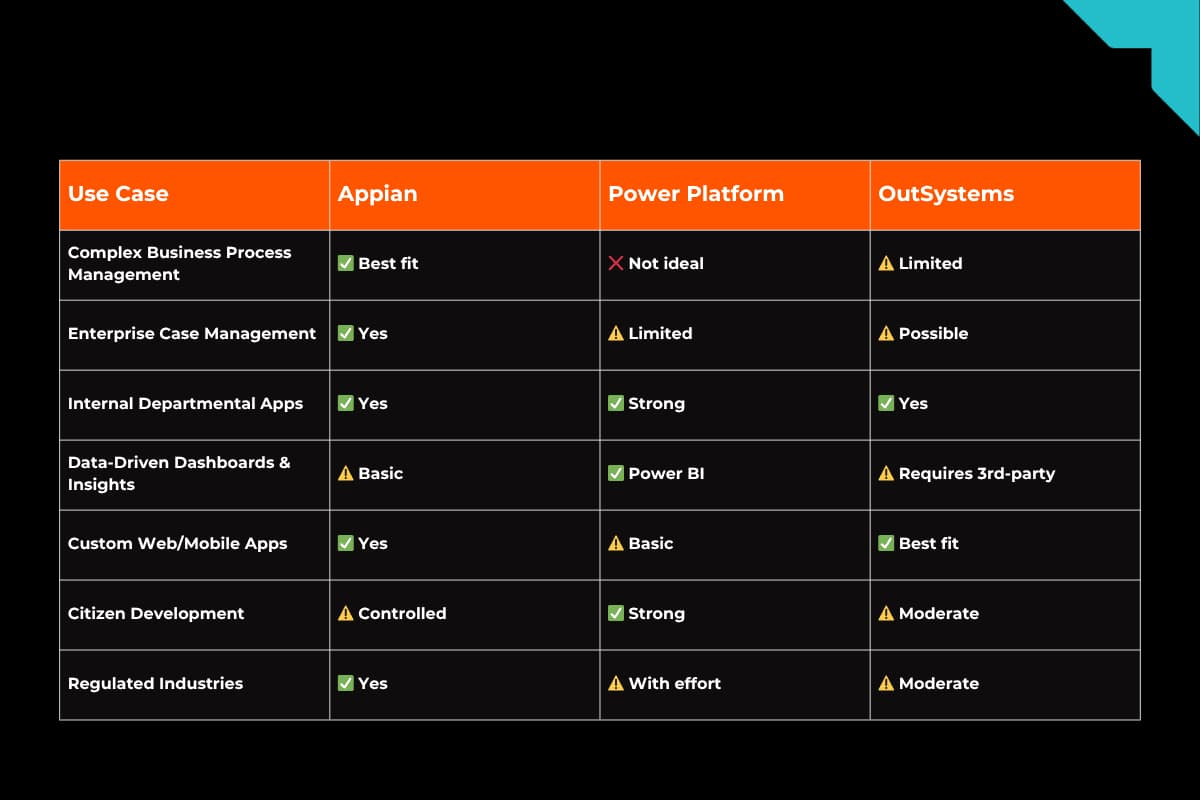
Ideal Use Cases
Final Verdict: Which Low-Code Platform is Right for You?
Choosing the right low-code platform for your enterprise is not a one-size-fits-all decision. It depends heavily on your organization’s priorities, existing technology landscape, regulatory environment, and the maturity of your automation strategy. Each of these platforms Appian, Power Platform, and OutSystems offers distinct strengths and trade-offs. The right choice lies in aligning platform capabilities with your specific business context.
Appian is purpose-built for enterprises that demand end-to-end process automation, data orchestration, and governance at scale. It stands out for its unified automation stack that seamlessly integrates workflows, RPA, business rules, AI, and case management, without needing multiple products or licensing models. Appian’s robust governance controls, security-first design, and deep compliance readiness make it a top choice for regulated industries like banking, insurance, healthcare, and government. If your goal is to automate complex, mission-critical processes across multiple departments, with full visibility and centralized control, Appian offers a mature, enterprise-grade foundation. It may require upfront investment and a dedicated CoE, but the long-term value and scalability are significant.
Power Platform, on the other hand, is a natural fit for organizations already embedded in the Microsoft ecosystem. If your enterprise runs on Microsoft 365, Azure, and Dynamics, Power Platform offers a fast path to app development and automation with lower barriers to entry. It excels at departmental use cases, citizen development, and extending existing Microsoft tools. However, scaling Power Platform enterprise-wide demands rigorous governance frameworks to avoid sprawl and ensure data integrity. While powerful, it works best in organizations that can balance rapid delivery with disciplined oversight, and where integration within the Microsoft stack is a key enabler.
OutSystems is often chosen by organizations that need more control over custom application development but still want to benefit from low-code speed. Its strong capabilities in UI-rich apps, integrations, and complex customizations make it appealing to enterprises with advanced IT teams and nuanced development requirements. However, its governance, DevOps, and compliance capabilities are more manual compared to Appian, and may require additional tooling or frameworks. If your use cases lean more toward custom app delivery than process automation, and if you have the technical depth to govern and scale it properly, OutSystems is a strong contender.
Ultimately, the choice comes down to your enterprise’s core objectives:
For large-scale, process-centric automation with enterprise-grade governance: Appian is the clear frontrunner.
For fast innovation within Microsoft environments and citizen-led apps: Power Platform offers speed and accessibility.
For complex, customizable apps with developer flexibility: OutSystems provides depth and control.
Building the Right Low-Code Strategy for Long-Term Impact
Choosing a low-code platform is not merely a technical decision but a foundational choice that shapes your digital transformation journey. Appian, Power Platform, and OutSystems all offer compelling capabilities. But the right platform for your enterprise depends on far more than features alone. It requires alignment with your business objectives, process maturity, integration needs, regulatory landscape, and long-term automation strategy. Too often, organizations rush into platform decisions without a clear view of the downstream implications, leading to fragmented deployments, governance challenges, and missed ROI targets. The most successful enterprises approach low-code with intentionality: defining the right use cases, building a scalable governance framework, and ensuring their teams are empowered to deliver at speed and scale.
At LOWCODEMINDS, we bring that clarity. We are technology-agnostic by design, and our approach is rooted in strategic process thinking. As certified partners for both Appian and Microsoft Power Platform, we’ve helped Fortune 500 and mid-sized enterprises alike evaluate, implement, and scale low-code platforms that deliver meaningful business outcomes. Our deep understanding of process orchestration, enterprise integration, and automation strategy makes us more than implementation experts.
Whether you’re still comparing platforms or already scaling an existing implementation, our team can guide you across every stage of the journey, from platform evaluation and CoE setup to enterprise architecture alignment and ROI measurement. Low-code is a strategic lever. The right partner turns it into lasting impact. Let’s create that impact, together.
LOWCODEMINDS is a global leader in AI-led enterprise process orchestration and Knowledge Work Automation, transforming fragmented workflows into orchestrated, AI-driven decision systems that help enterprises modernize and scale business operations. Recognized as a Top Player and Contender in the ISG Provider Lens® Intelligent Automation Services 2025 (U.S.) study, the company is at the forefront of next generation automation and enterprise transformation.
LOWCODEMINDS helps enterprises transform knowledge intensive and compliance heavy enterprise value chains through trusted, governed, and scalable AI automation that delivers measurable operational and financial outcomes. Powered by App Labs, its dedicated innovation division, the company has developed 7+ Enterprise Value Chain Frameworks, 20+ reusable Agentic AI Accelerators, and 18+ enterprise ready solutions across industries including BFSI, Legal, Manufacturing, Retail, CCM, and Telecommunications.

Headquarters:
8, The Green Ste B, Dover, DE 19901.
[email protected]
(276) 451-3607
2026
LOWCODEMINDS | Privacy Policy