Fund Publishing Automation with AI | LOWCODEMINDS

Fund Publishing Automation: How Asset Managers Can Use AI
A fund report has been approved, uploaded and checked. The product page opens correctly, the download link works, and the team closes the publishing request. Yet another page still links to last quarter’s report, while a regional website displays an older AUM figure.
For the operations team, this means reopening the request, finding every affected location, making corrections and checking the update again. For an investor or intermediary, it means encountering different information about the same fund.
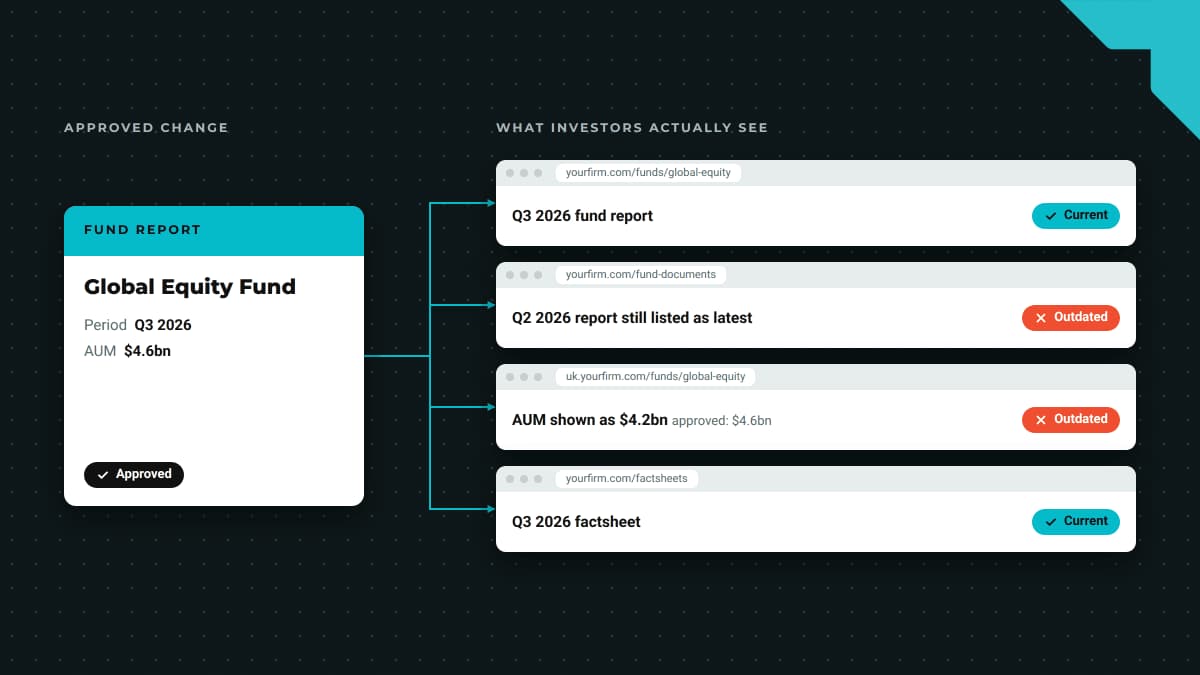
This is the problem fund publishing automation needs to solve. Preparing a correct document is one part of the work; making sure the approved information reaches every intended destination is another.
AI can help asset managers identify documents, extract details and review unstructured instructions. Combined with workflow automation, system integration and verification, it can connect those activities to the approvals and publishing controls that determine what goes live.
An approval confirms the intended change, while verification confirms what investors can actually see.
What is fund publishing automation?
Fund publishing automation connects the steps needed to receive, validate, approve and publish fund documents and data, then checks the result across the intended websites and channels.
It can support recurring investment product operations such as fund fact sheet publishing, distribution notice updates, ESG and stewardship report publishing, and changes to assets under management (AUM) and other fund key facts.
AI assists with tasks that require interpretation, such as reading PDFs or identifying a reporting period from a document’s contents. Defined business rules handle calculations, file naming, version control and page mappings, while authorised people review exceptions and approve changes according to the firm’s policy.
The objective is to reduce repetitive publishing work while keeping the source information, approval and published result connected.
Why fund documents and data become inconsistent
The difficulty often sits between systems.
An approved report may be stored in a document repository, its publishing instructions may arrive by email, and its website links may be managed separately in a content management system (CMS). A spreadsheet may hold the updated figures, while a request queue records whether the work is complete.
People connect these pieces by reading the instructions, identifying the affected pages, entering metadata and checking the result. As the number of funds, share classes and publishing destinations grows, the same update requires more coordination.
Several errors can pass basic checks:
- The link works, but opens a report from the wrong period.
- The document is correct, but belongs to a different fund or share class.
- A new report appears on the page, but the superseded version remains listed as current.
- An approved figure is updated on one page and missed on another.
- A completion message is sent before the website has refreshed.
None of these necessarily produces a broken page. A reliable publishing workflow therefore needs to check whether the live information matches the approved change, rather than simply whether a file uploaded successfully.
How to automate fund document publishing
Start by connecting the approved source, the publishing instructions and the destinations within one workflow.
When a document arrives, AI can extract details such as its fund name, category and reporting period. The workflow checks these against approved records and flags conflicting or missing information for review.
Business rules then determine the filename, version handling and destination pages. Before approval, the reviewer should see which documents or figures are changing, where they will appear and which validation checks have passed.
After approval, the workflow publishes through supported system interfaces and verifies the live result. A request remains open if a destination cannot be updated or the published content does not match the approved version.
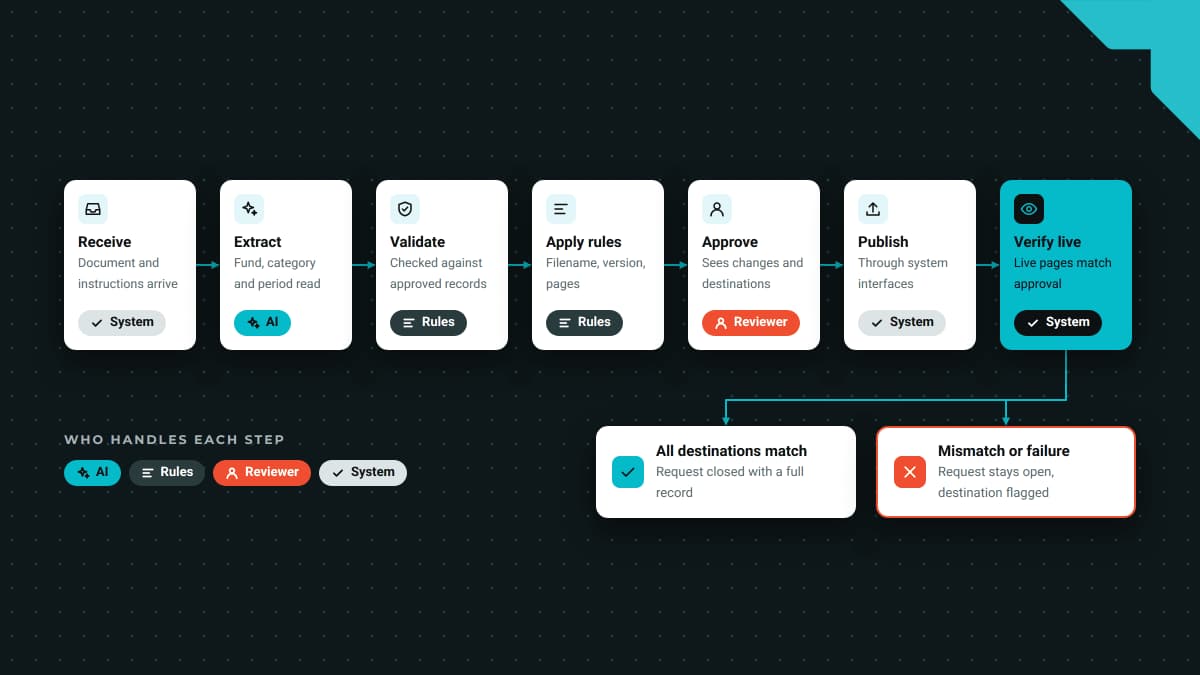
This approach connects preparation, approval and verification. It also creates a record that the team can use later to establish what changed, who authorised it and what readers could access after publication.
Three investment product operations workflows worth automating
1. Distribution notice publishing
A recurring distribution notice may need to be stored in a repository, linked from the relevant fund page and made available to stakeholders. The work is repetitive, but each notice still needs the correct fund, period and approved version.
For US registered funds, Section 19(a) and Rule 19a-1 address disclosure of the sources of certain distributions. Publishing a notice on a website is distinct from meeting the applicable shareholder delivery requirements.
For the website publishing component, AI can read the approved notice, extract identifying details and prepare a draft stakeholder update. Business rules control filing and page placement, while a reviewer resolves unclear information and authorises the change.
The important check happens after publication. A successful upload does not establish that the new notice is accessible from the live page. The workflow should confirm that the correct document is available before releasing a completion message.
If the website refresh is delayed, it can retry within a defined window. If the notice remains unavailable, the request should return to the team with the outstanding destination identified.
This reduces the need for people to repeatedly reopen pages and confirm whether an update has appeared.
2. ESG and stewardship report publishing
Engagement reports, proxy voting reports and other stewardship documents may arrive in batches with similar titles or inconsistent filenames. Identifying each report and matching it to the correct period can take considerable attention.
AI can assist by reading the document’s contents and proposing its category and reporting period. Those details should be checked against the expected publishing schedule, with ambiguous documents routed to a reviewer.
The workflow also needs to distinguish current documents from historical records. Adding a new report without correctly replacing the existing entry can leave two working links on the page, even though only one should appear as the current report.
Verification should check the identity and period of the linked documents, while retaining historical material wherever the firm’s policy requires it.
When wording changes, AI can highlight differences and possible omissions against an approved checklist. That gives the reviewer a more focused starting point, while the judgement about whether the wording is acceptable remains with the appropriate person.
The operational benefit comes from reducing repeated identification and comparison work, while bringing unclear documents and conflicting versions to the team’s attention.
3. AUM and fund key facts updates
AUM, fund size, fees and other key facts may appear across several product pages and website components. Updating a small set of values can therefore affect more locations than the person handling the request initially sees.
Most of this work should use conventional automation. Figures should come from approved sources, with defined rules for dates, currencies, units, rounding and fund or share-class mappings.
AI may help interpret accompanying instructions or prepare a change summary. Numerical values and calculations should remain governed by the approved data and rules.
Before publication, the workflow identifies the destinations affected by each change and flags incorrect mappings. After publication, it compares the displayed values with the approved update.
This gives the approver a clearer view of the change and reduces the manual effort involved in finding and checking every place a figure appears.
Where AI helps and where business rules should lead
The decision to use AI should depend on the task. Reading an inconsistently formatted PDF requires a different approach from rounding an approved figure or applying a retention policy.
| Task | Appropriate approach |
|---|---|
| Identify a report from its contents | AI-assisted classification, checked against expected categories |
| Extract fund names, dates and document metadata | AI-assisted extraction with source validation |
| Apply naming, retention and version policies | Defined business rules |
| Calculate and round published figures | Conventional automation using approved data |
| Highlight changes in report wording | AI-assisted comparison for human assessment |
| Approve publication | Authorised reviewer according to policy |
| Check live documents, links and figures | Automated verification against the approved update |
An AI-generated classification should remain connected to the document evidence that supports it. Unclear results should be reviewed, rather than accepted because the model appears confident.
This is also why some fund publishing procedures need very little AI. Where the work consists mainly of predictable data updates, conventional automation may provide most of the value.
Keeping approvals and publication records connected
Approval is most useful when the reviewer can see the full change.
That includes the source document or data, the destinations affected, the version being replaced and any unresolved issues. If the underlying information changes after approval, the workflow should apply the firm’s rules for obtaining approval again.
Publication also needs an accurate status. If three destinations update successfully and a fourth fails, the request should show that partial result rather than mark the entire change complete.
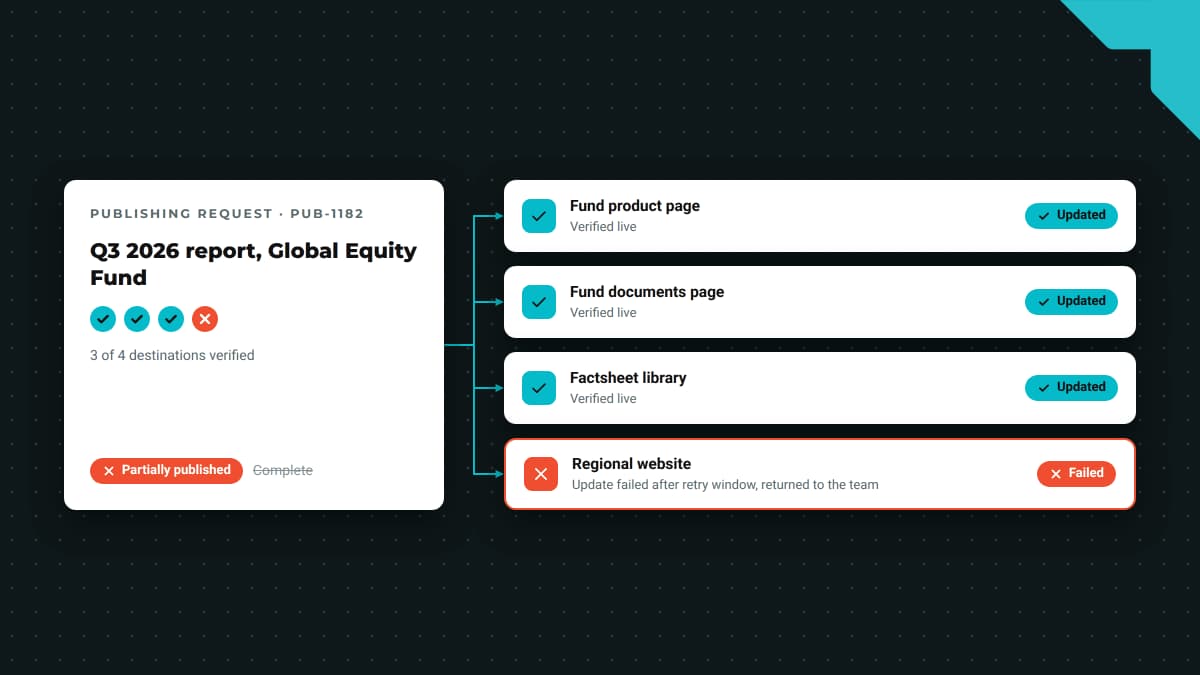
A useful publication record connects:
- The source documents and data versions.
- Validation checks and exceptions.
- The person who approved the change.
- The destinations updated.
- The live verification results.
- Any corrections or unresolved failures.
This can reduce the effort needed to answer a later question about how a document reached the website. It also helps the team resolve a failed update without reconstructing the process from emails and system logs.
Can fund publishing automation use existing systems?
Often, an asset manager can automate the workflow around its existing document repositories, CMS platforms, data sources and request queues.
The integration work depends on the interfaces those systems provide, the permissions available and how reliably published changes can be checked. Some environments may require connectors or improvements to document metadata and fund identifiers.
Before considering replacement software, establish where approved information originates, which destinations use it and how updates are currently verified. This helps distinguish a system limitation from a gap in the process connecting the systems.
It also keeps the project focused on the publishing work that needs improvement.
What business value should an asset manager measure?
The benefits should be assessed against the current process.
Less manual filing and data entry can reduce effort, but repeated checking and correction work also deserve attention. An operations team may spend as much time confirming an update as making it, particularly when the same information appears across several channels.
A pilot should measure manual effort per publishing cycle, time from approved input to verified publication, corrections required after publication and the time needed to retrieve a complete approval record.
Exception handling matters too. Automation should make difficult cases easier to identify and resolve, rather than moving them into a separate queue with no clear owner.
These measures provide a more useful business case than counting how many tasks have been automated.
Where to start with fund publishing automation
Choose one recurring procedure with a clear owner, approved source information and identifiable publishing destinations.
Map how the work moves from receipt to verified publication, including the decisions people make along the way. Separate document interpretation from established rules, then identify where the team spends the most time entering information, checking pages or correcting updates.
The pilot should test difficult cases as well as routine ones: an unclear reporting period, a duplicate report, a changed document after approval, an unavailable destination and a delayed website refresh.
Once the workflow handles those situations reliably, shared capabilities such as fund identification, approvals and live-page verification can support additional procedures.
Talk to LOWCODEMINDS about fund publishing automation
If your team repeatedly uploads fund documents, checks figures across websites or reopens requests to correct missed updates, there is a practical opportunity to improve how that work is managed.
At LOWCODEMINDS, we bring together AI, workflow orchestration and enterprise integration to automate knowledge-intensive business processes. For fund publishing, that means examining how documents and data move through existing systems, identifying repetitive work and designing the approvals, exception handling and verification needed around it.
Explore our intelligent automation capabilities or contact LOWCODEMINDS to discuss fund publishing automation. We can review your current process and identify where AI and workflow automation could reduce manual effort and improve publishing consistency.
Document intake, metadata extraction, file naming, version handling, approval routing, page updates and checks on published content can be automated. Human review should remain for unclear documents and approvals required by the firm’s policy.
Connect approved source information to known publishing destinations, apply defined update rules and verify each destination after publication. The workflow should show missed or failed updates rather than treat the entire request as complete.
No. AI is useful for interpreting documents and written instructions. Calculations, rounding, file naming, version rules and numerical checks can largely use conventional automation.
Yes. It can require authorised approval before publication and retain the source version, validation results, reviewer actions and live verification outcome. The record needs appropriate access and retention controls.
About the Author

Kawisha Nilmani
Kawisha Nilmani specializes in AI-driven automation at LOWCODEMINDS. Her work focuses on agentic AI and workflow automation, with an emphasis on making business rules auditable and decisions traceable.
A Claude Certified Architect, Kawisha develops practical AI solutions that help teams improve accuracy and efficiency in complex business processes while retaining the controls needed to review and manage automated decisions.
LOWCODEMINDS is a global leader in AI-led enterprise process orchestration and Knowledge Work Automation, transforming fragmented workflows into orchestrated, AI-driven decision systems that help enterprises modernize and scale business operations. Recognized as a Top Player and Contender in the ISG Provider Lens® Intelligent Automation Services 2025 (U.S.) study, the company is at the forefront of next generation automation and enterprise transformation.
LOWCODEMINDS helps enterprises transform knowledge intensive and compliance heavy enterprise value chains through trusted, governed, and scalable AI automation that delivers measurable operational and financial outcomes. Powered by App Labs, its dedicated innovation division, the company has developed 7+ Enterprise Value Chain Frameworks, 20+ reusable Agentic AI Accelerators, and 18+ enterprise ready solutions across industries including BFSI, Legal, Manufacturing, Retail, CCM, and Telecommunications.

Headquarters:
8, The Green Ste B, Dover, DE 19901.
[email protected]
(276) 451-3607
2026
LOWCODEMINDS | Privacy Policy