How to Automate Telecom Tower and Site Operations

How to Automate Telecom Tower and Site Operations

Telecom tower and site operations involve a constant flow of work across assets, field teams, vendors, tenants, maintenance teams, and infrastructure managers.
An equipment issue is reported. Someone needs to determine its priority and assign the right vendor. An SLA starts running. The vendor needs site and asset information. The repair needs to be tracked. If the issue remains unresolved, it needs to be escalated. Once completed, the maintenance history and site records need to be updated.
When these steps depend on emails, spreadsheets, phone calls, and disconnected systems, even relatively straightforward activities can require significant manual coordination.
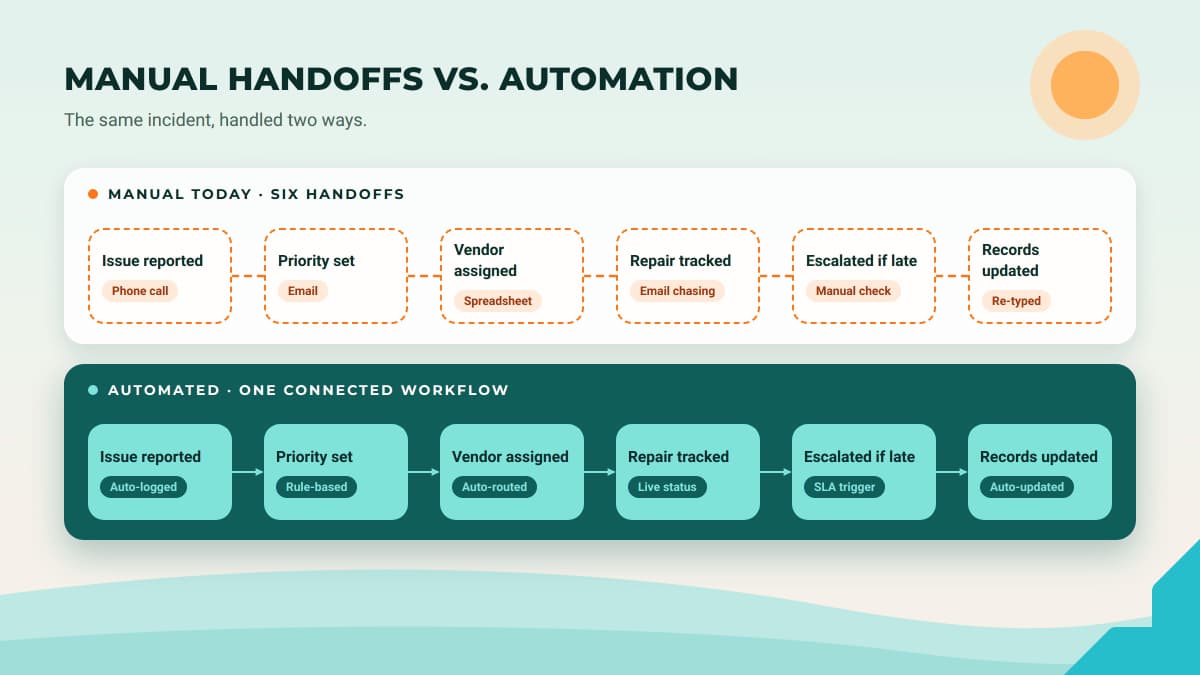
Telecom site automation uses digital workflows to connect and automate repetitive operational activities across tower sites, assets, vendors, incidents, maintenance, and site development. Instead of automating isolated tasks, organizations can orchestrate the end-to-end processes required to operate distributed telecom infrastructure.
For telecom operators, TowerCos, infrastructure providers, and service providers, this can reduce manual coordination while improving visibility and consistency across site operations.
What Is Telecom Site Automation?
Telecom site automation is the use of workflow automation, business rules, integrations, notifications, and data to automate operational processes across telecom towers and sites.
This can include activities such as:
- Routing site incidents to the appropriate team or vendor
- Triggering SLA-based escalations
- Scheduling preventive maintenance
- Assigning maintenance activities
- Managing site development approvals
- Updating asset and maintenance records
- Coordinating vendor activities
- Sending operational alerts and notifications
- Tracking milestones and outstanding actions
- Generating dashboards and operational reports
The objective is not to remove people from site operations. It is to reduce the manual work required to move information, assign tasks, follow up on activities, and keep multiple teams coordinated.
Why Are Telecom Tower and Site Operations Difficult to Automate?
Telecom infrastructure operations are distributed by nature.
Sites may be spread across different regions. Equipment varies from one location to another. Different vendors may be responsible for different services. Field teams need access to accurate information. Maintenance schedules vary by asset. Incidents can have different priorities and SLAs.
At the same time, the systems supporting these operations may also be fragmented.
A telecom operator may have asset information in one application, incidents in another, vendor details in spreadsheets, maintenance schedules in separate trackers, and project information for new sites somewhere else.
Automating one step inside one of these systems does not necessarily solve the larger problem.
For example, automatically creating an incident ticket helps. But if someone still has to manually identify the asset, find the responsible vendor, check the SLA, send an email, follow up on the repair, update another system, and prepare a separate report, much of the process remains manual.
This is why effective telecom site automation should focus on end-to-end workflows rather than individual tasks.
Which Telecom Tower and Site Operations Can Be Automated?
Not every activity needs to be automated. The best opportunities are usually repetitive processes that involve predictable rules, multiple handoffs, frequent follow-ups, or information moving between systems.
Here are some of the most practical areas.
1. Incident Management and Escalation
Site incidents are a strong candidate for workflow automation because they typically follow a defined sequence of activities. An incident can be captured through a central system and automatically associated with the relevant site and asset.
Based on predefined rules, the workflow can determine:
- Incident category
- Priority
- Responsible team
- Assigned vendor
- Applicable SLA
- Required escalation path
The appropriate people can then be notified automatically. If the issue is not acknowledged or resolved within the required timeframe, the system can trigger an escalation rather than relying on someone to manually monitor the incident.
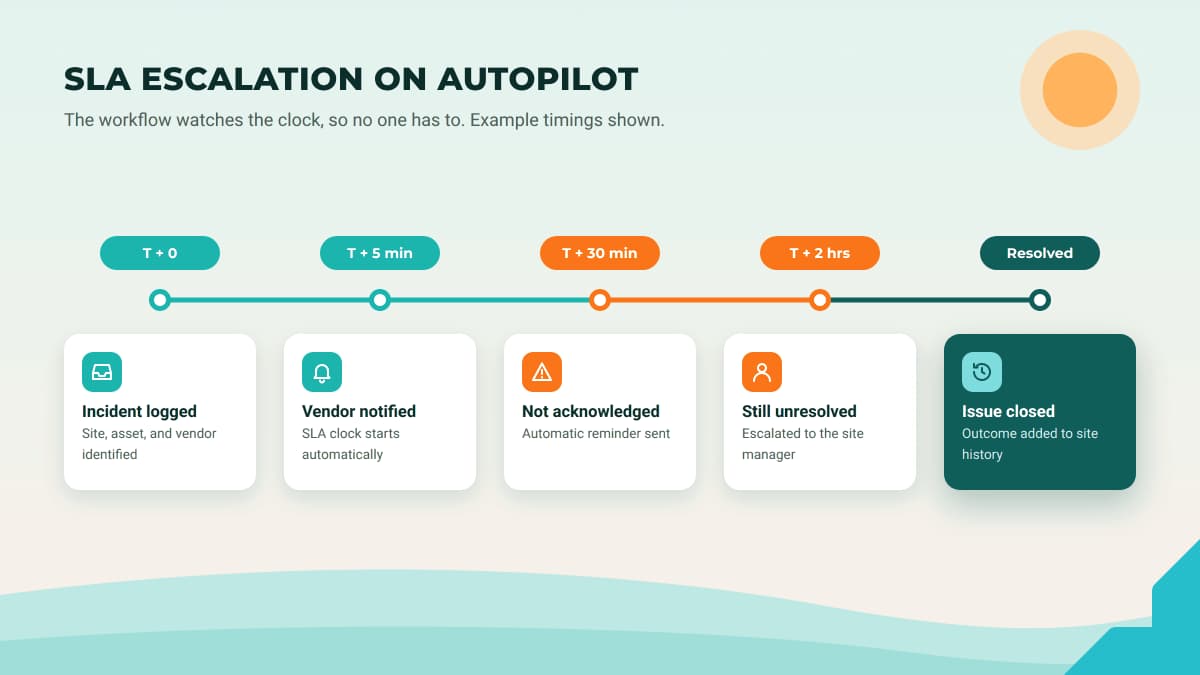
Once the issue is resolved, the outcome can become part of the site's incident and asset history.
This creates a continuous record that can later help teams identify recurring problems across particular assets or locations.
2. Preventive Maintenance Scheduling
Preventive maintenance often involves recurring work that is well suited to automation.
Instead of maintaining separate schedules and manually reminding teams or vendors, maintenance activities can be triggered according to predefined intervals, asset information, or operational requirements.
The workflow can automatically create the maintenance activity, assign responsibility, notify the relevant team or vendor, track completion, and update the asset's maintenance history.
If an activity is overdue, escalation rules can be triggered automatically. This gives operations teams better visibility into what has been completed, what is due, and what requires attention across the site portfolio.
3. Moving Toward Predictive Maintenance
Preventive maintenance follows predefined schedules. Predictive maintenance goes further by using operational and historical data to identify when an asset may require attention.
Data such as equipment performance, previous incidents, maintenance history, and other operational indicators can help identify patterns that suggest potential issues.
When those signals are connected to maintenance workflows, an alert does not need to remain simply an insight on a dashboard.
It can initiate action. For example, the system could flag an asset requiring inspection, create a maintenance task, assign the appropriate team, and track the activity through completion.
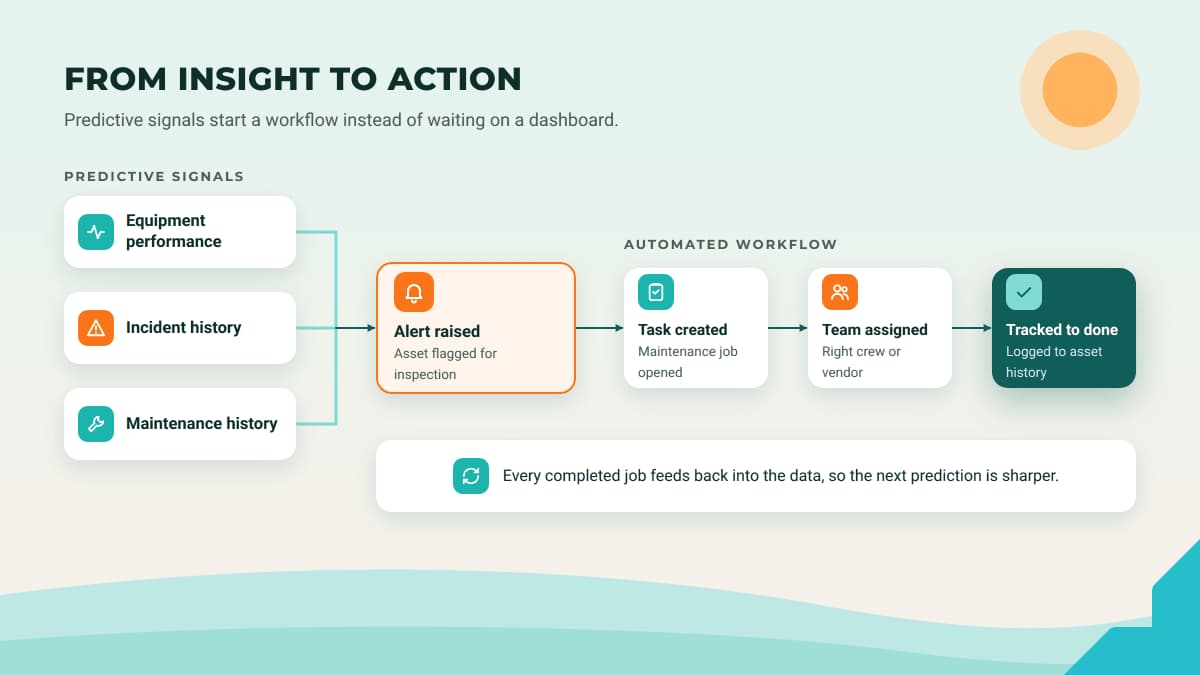
This is where analytics and workflow automation become significantly more useful together.
4. Vendor Assignment and SLA Management
Vendor coordination can create substantial administrative work when site portfolios involve multiple external service providers.
Instead of manually determining which vendor supports a particular site or asset, predefined rules can route work to the appropriate provider.
Once assigned, the workflow can track:
- Acknowledgement
- Response time
- SLA deadlines
- Work status
- Resolution
- Escalations
- Completion
Operations teams can then monitor vendor activity from a common view rather than relying on emails and individual follow-ups. Over time, the same operational data can provide a clearer picture of vendor performance across sites.
5. New Site Development Workflows
Building a new telecom site involves multiple stages and stakeholders.
Site planning, resource allocation, engineering, contractors, approvals, compliance requirements, documentation, and deployment milestones may all need to be coordinated before the site becomes operational.
Workflow automation can help standardize this process.
For example, completing one stage can automatically initiate the next approval or activity. Required stakeholders can be notified when action is needed. Missing approvals or overdue milestones can be escalated.
Project teams can see where each site stands without manually consolidating progress from different trackers.
And once development is complete, relevant information can remain connected to the site's ongoing operational record.
6. Asset Updates and Lifecycle Workflows
Asset management involves more than knowing what equipment exists at a site. Assets are installed, inspected, maintained, repaired, replaced, relocated, and eventually retired.
Each stage can involve documentation, approvals, system updates, and coordination between teams. Automated workflows can help ensure that asset records remain aligned with operational activity.
For example, when equipment is replaced following an incident, the process can require the appropriate approvals, record the replacement, update asset information, and maintain the historical relationship between the old and new equipment.
This reduces the risk of asset records becoming disconnected from what is actually happening at the site.
7. Tenant and Site Resource Workflows
For TowerCos and infrastructure providers supporting multiple tenants, site resources need to be coordinated carefully.
Tenant-related processes can involve agreements, space allocation, utilities, infrastructure availability, documentation, and internal approvals.
Structured workflows can help teams manage these activities consistently and maintain a clearer record of how sites and resources are being utilized.
Automation can also reduce the manual follow-ups required when a tenant request needs input or approval from several teams.
8. Operational Notifications and Escalations
A surprising amount of operational effort goes into simply reminding people that something needs attention.
Maintenance is due.
An incident is approaching its SLA.
An approval is pending.
A vendor has not responded.
A development milestone is overdue.
A document needs to be reviewed.
These are relatively simple activities, but across a large telecom site portfolio they can generate considerable administrative work.
Automated notifications and escalation rules can ensure that the right people are alerted based on the status and urgency of the underlying workflow. Teams can spend less time chasing updates and more time resolving the actual issue.
9. Reporting and Operational Visibility
Reporting is another area where manual work can accumulate.
When site information is spread across multiple systems and spreadsheets, operations teams may need to consolidate data before they can understand what is happening across the network.
Connecting operational workflows to a common platform makes reporting a by-product of the work being performed.
Dashboards can provide visibility into areas such as:
- Open and resolved incidents
- SLA performance
- Maintenance completion
- Overdue activities
- Asset health
- Vendor performance
- Site development progress
- Site and resource utilization
This gives operational leaders a more current view without relying entirely on manually prepared reports.
Why Automating Individual Tasks Is Not Enough
A common mistake in automation programs is to automate whichever manual task is easiest to identify.
That can produce quick improvements, but telecom site operations rarely consist of isolated tasks. Consider maintenance.
Automatically scheduling a maintenance activity solves one step.
But the wider process may involve identifying the correct asset, assigning a vendor, checking site access, notifying stakeholders, tracking SLA performance, recording work completed, updating the asset history, and escalating exceptions.
If these activities remain disconnected, automation simply moves the bottleneck elsewhere.
The larger opportunity is to connect the workflow from beginning to end.
This is where a tower and site management platform can provide more value than a collection of individual automation tools.
The LOWCODEMINDS Tower and Site Management Solution brings telecom assets, vendors, tenants, incidents, maintenance, new site development, and operational data together on a centralized platform, allowing workflows to operate across these different areas rather than in isolation.
Explore the Tower and Site Management Solution →
How to Approach Telecom Site Automation
Organizations do not need to automate every tower and site process at once.
A more practical approach is to start with workflows where manual coordination is creating measurable operational friction.
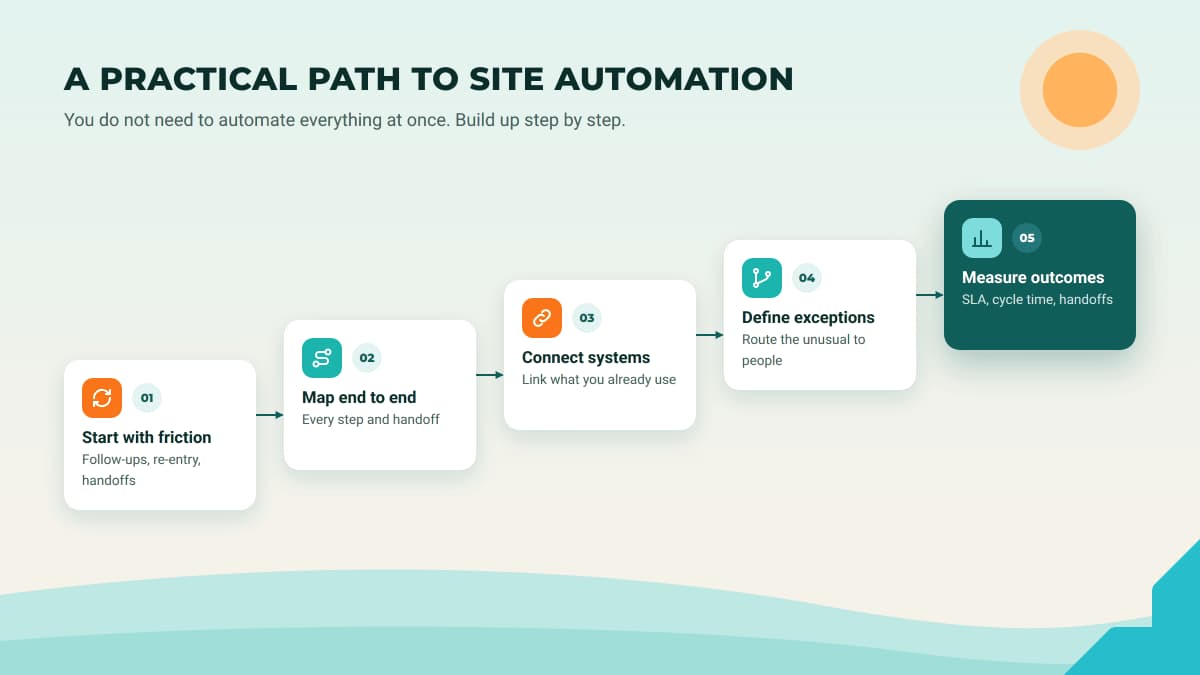
Start with High-Friction Processes
Look for activities involving:
- Frequent manual follow-ups
- Repeated data entry
- Multiple handoffs
- Spreadsheet-based tracking
- Email-based approvals
- SLA monitoring
- High incident volumes
- Recurring maintenance activities
- Manual reporting
These are usually stronger automation candidates than processes that occur infrequently or require significant human judgment.
Map the End-to-End Workflow
Do not examine only the obvious manual task.
Understand what happens before it, what happens afterwards, which systems are involved, who needs to make decisions, and where information changes hands.
This helps avoid automating one step while leaving the surrounding process fragmented.
Connect Existing Systems
Automation does not necessarily require replacing every system already used by the organization.
A site management platform can act as an operational layer connecting existing enterprise applications, operational systems, data sources, and third-party tools.
The goal should be to reduce the amount of manual effort required to move information between them.
Define Exceptions
Not every decision should be automated.
Workflows should distinguish between routine activities that can proceed automatically and exceptions that require human review.
For example, a standard maintenance request may be automatically assigned according to predefined rules, while an unusual or high-risk incident may require approval or specialist intervention.
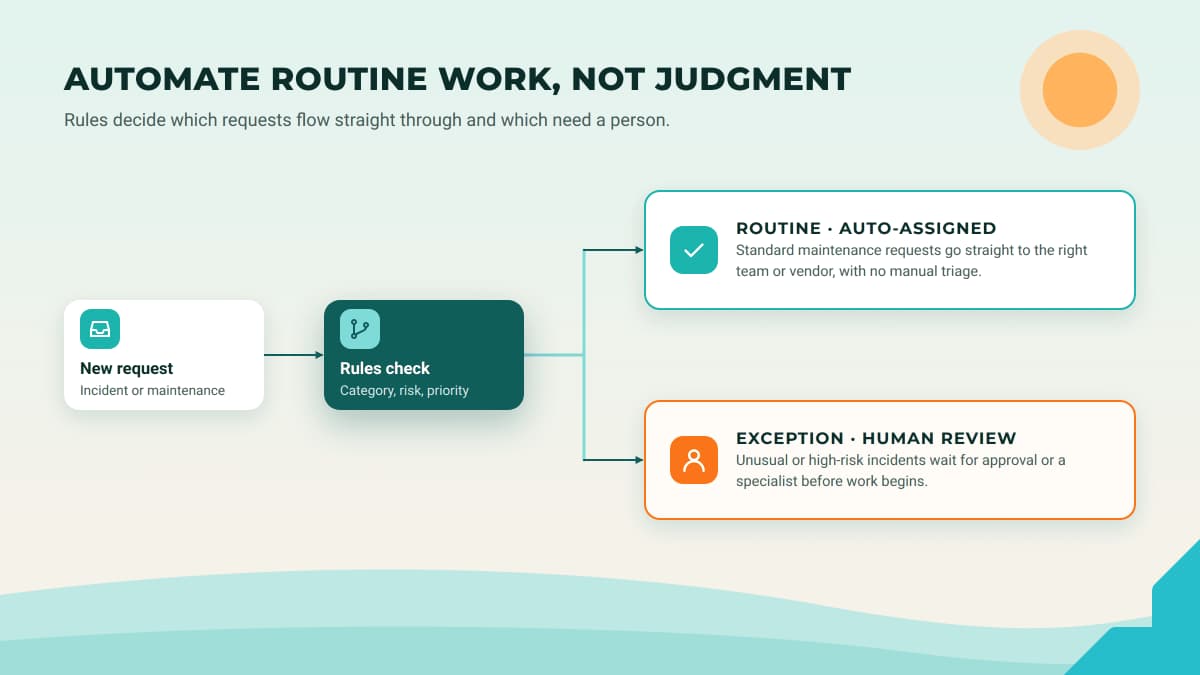
Good automation should make human involvement more purposeful rather than trying to eliminate it.
Measure Operational Outcomes
The success of telecom site automation should not be measured by the number of workflows automated.
More useful measures include:
- Incident response and resolution times
- Maintenance completion rates
- SLA adherence
- Number of manual handoffs
- Overdue activities
- Vendor response times
- Site development cycle times
- Repeated incidents
- Manual reporting effort
These measures help determine whether automation is improving the operation rather than simply digitizing it.
What Should You Look for in a Telecom Site Automation Platform?
For organizations evaluating a platform, the ability to automate workflows is only one consideration.
The platform should also support the operational context around those workflows.
Look for capabilities that allow you to:
- Manage multiple telecom sites and asset types
- Configure workflows and business rules
- Automate notifications and escalations
- Manage incidents and maintenance
- Coordinate vendors and tenants
- Track SLAs and responsibilities
- Manage new site development
- Integrate existing systems and data
- Create operational dashboards and reports
- Adapt processes as requirements change
- Scale across a growing site portfolio
A platform built on low-code can also make it easier to adapt workflows as operational requirements evolve without depending entirely on long traditional development cycles.
When Is It Time to Automate Telecom Site Operations?
Automation becomes particularly relevant when the complexity of coordinating work begins to affect operational performance.
Common signs include:
- Teams spend significant time following up on routine activities
- Site information is spread across multiple spreadsheets or systems
- Incident escalation depends on individuals remembering to act
- Maintenance activities are difficult to track across sites
- Vendor SLA performance lacks visibility
- The same data is entered into multiple systems
- New site development requires multiple manual trackers
- Operational reports take significant effort to prepare
- Management lacks a current view across the site portfolio
If several of these are familiar, the underlying issue may not be one inefficient task. It may be that site operations have outgrown the processes and tools currently supporting them.
From Manual Coordination to Connected Telecom Site Operations
The real opportunity in telecom site automation is not to automate every human activity.
It is to remove unnecessary manual coordination from the processes that keep telecom infrastructure operating.
When incidents, maintenance, assets, vendors, tenants, and site development are connected through common workflows, teams can spend less time moving information between systems and more time managing the network itself.
For telecom operators, TowerCos, infrastructure providers, and service providers looking to make that transition, LOWCODEMINDS' Tower and Site Management Solution provides a unified platform for managing and automating telecom tower and site operations while integrating with the existing technology environment.
Still managing tower and site operations across spreadsheets, emails, and disconnected systems?
See how LOWCODEMINDS can help connect and automate your telecom site operations across assets, vendors, tenants, incidents, maintenance, and new site development.
Telecom site automation uses digital workflows, business rules, integrations, notifications, and operational data to automate repetitive processes across telecom sites, assets, vendors, incidents, maintenance, and site development.
Common opportunities include incident routing and escalation, preventive maintenance scheduling, vendor assignment, SLA monitoring, approvals, asset updates, site development workflows, notifications, and operational reporting.
Yes. Automation platforms can integrate with existing enterprise and operational systems, allowing workflows and data to move across the technology environment without necessarily replacing every existing application.
Start by identifying high-friction workflows involving repetitive manual work, multiple handoffs, frequent follow-ups, or disconnected systems. Map the complete process, identify where automation provides value, define exceptions requiring human judgment, and measure the resulting operational improvement.
LOWCODEMINDS is a global leader in AI-led enterprise process orchestration and Knowledge Work Automation, transforming fragmented workflows into orchestrated, AI-driven decision systems that help enterprises modernize and scale business operations. Recognized as a Top Player and Contender in the ISG Provider Lens® Intelligent Automation Services 2025 (U.S.) study, the company is at the forefront of next generation automation and enterprise transformation.
LOWCODEMINDS helps enterprises transform knowledge intensive and compliance heavy enterprise value chains through trusted, governed, and scalable AI automation that delivers measurable operational and financial outcomes. Powered by App Labs, its dedicated innovation division, the company has developed 7+ Enterprise Value Chain Frameworks, 20+ reusable Agentic AI Accelerators, and 18+ enterprise ready solutions across industries including BFSI, Legal, Manufacturing, Retail, CCM, and Telecommunications.

Headquarters:
8, The Green Ste B, Dover, DE 19901.
[email protected]
(276) 451-3607
2026
LOWCODEMINDS | Privacy Policy