Manual Reconciliation Challenges & How to Automate

Manual Reconciliation: Common Challenges and How to Automate the Process
Reconciliation is one of the most important controls in finance operations, but in many organizations, it is also one of the most manual. Finance teams routinely spend hours extracting data from ERP systems, billing platforms, bank statements, payment systems, contracts, and spreadsheets before comparing records, investigating mismatches, and determining which numbers are correct.
This approach may work when transaction volumes are relatively low. As an organization grows, however, the number of transactions, systems, customers, contracts, pricing structures, and exceptions grows with it. What was once a manageable finance activity can quickly become a significant operational bottleneck.
Manual reconciliation can delay billing, extend month-end close, increase the risk of errors, and consume valuable finance capacity that could otherwise be spent on analysis and decision-making.
Reconciliation automation changes this operating model. Instead of finance teams manually reviewing every transaction, automation can bring together data from multiple systems, apply predefined matching rules, identify discrepancies, and route only genuine exceptions for human review. AI can extend this further by helping organizations reconcile semi-structured information such as contracts, invoices, and supporting documents.
The objective is not simply to eliminate spreadsheets. It is to move finance teams from transaction-by-transaction reconciliation to exception-based finance operations.
What Is Manual Reconciliation?
Manual reconciliation is the process of comparing financial records across two or more data sources to verify that transactions, balances, amounts, and other financial information are consistent.
For example, a finance team may compare invoices generated by a billing system against contractually agreed customer rates, match payments received against outstanding accounts receivable, reconcile bank transactions with entries in the general ledger, or compare transactions between different entities during intercompany reconciliation.
In a manual environment, much of this work happens through spreadsheets, exports, emails, and individual verification. Employees download information from different systems, normalize the data, perform lookups or comparisons, identify mismatches, investigate the underlying causes, and make corrections.
The difficulty is not reconciliation itself. The challenge is performing it reliably when thousands or millions of transactions are distributed across systems that were never designed to work together.
Why Does Manual Reconciliation Become Difficult as Transaction Volumes Grow?
Reconciliation workload rarely grows in a simple, linear way.
As businesses expand, finance teams may need to reconcile more customers, invoices, payment methods, contracts, products, entities, currencies, bank accounts, and systems. Acquisitions and new technology platforms can introduce additional sources of financial data, while customized customer agreements can create increasingly complex validation requirements.
A reconciliation process that once involved comparing two spreadsheets can eventually require finance teams to navigate several systems and documents simply to understand why one transaction does not match another.
The result is often a growing dependency on manual effort. Organizations add people to manage increasing reconciliation volumes instead of addressing the underlying process.
This creates several recurring challenges.
7 Common Manual Reconciliation Challenges
1. Financial Data Is Spread Across Multiple Systems
The information required to complete a reconciliation may reside across ERP platforms, billing applications, CRM systems, banking portals, payment gateways, contract repositories, general ledgers, and spreadsheets.
Finance teams are often responsible for bringing these data sources together manually before reconciliation can even begin.
The more fragmented the technology environment becomes, the more time teams spend collecting and preparing data rather than resolving actual financial discrepancies.
2. High Transaction Volumes Make Manual Matching Unsustainable
Manual matching becomes increasingly difficult as transaction volumes increase.
Even when most transactions reconcile correctly, finance employees may still have to process or review large datasets to identify the relatively small percentage that require attention.
This creates an inefficient operating model in which significant human effort is spent confirming transactions that were already correct. Automation reverses this model by automatically clearing transactions that meet established matching criteria and presenting finance teams with exceptions.
3. Different Data Formats Create Matching Problems
A transaction may appear differently depending on the system from which it originates.
Customer names may use different conventions, transaction references may be incomplete, dates may differ because of processing delays, and amounts may vary because of taxes, fees, currency conversions, or adjustments.
These differences make exact matching difficult and often force finance teams to manually determine whether two records represent the same underlying transaction.
4. Exception Investigation Consumes Significant Finance Capacity
Identifying a mismatch is only the beginning. Finance teams must often determine why it occurred, which system contains the correct information, who owns the issue, whether supporting documentation exists, and what action is required to resolve it.
The investigation may involve searching through emails, reviewing contracts, contacting other departments, or tracing transactions across multiple systems.
When exception management itself is not structured, discrepancies can remain unresolved for days.
5. Manual Processes Increase the Risk of Errors
Spreadsheet formulas, copy-and-paste activities, manual data entry, and repetitive transaction reviews all introduce opportunities for human error.
A missed row, incorrect formula, duplicate transaction, or outdated pricing value can create downstream problems in billing, reporting, collections, or financial close.
The risk increases further when reconciliation depends heavily on employees knowing which files to use, which checks to perform, and which exceptions can be ignored.
6. Limited Audit Trails Make Reconciliation Difficult to Govern
Manual reconciliation often leaves fragmented evidence of how a discrepancy was identified and resolved. Some information may exist in spreadsheets, other explanations in email conversations, and final adjustments in the ERP system.
For finance leaders and auditors, reconstructing the complete history of a reconciliation can therefore require significant effort. A structured reconciliation workflow can maintain a record of matching decisions, exceptions, approvals, supporting information, and resolutions.
7. Reconciliation Delays Can Slow Billing and Month-End Close
Reconciliation is frequently connected to downstream finance activities. If billing data cannot be validated quickly, invoices may be delayed. If accounts cannot be reconciled, month-end close may take longer. If payment discrepancies remain unresolved, collections and cash application can also be affected.
The operational cost of manual reconciliation therefore extends beyond the reconciliation team itself.
What Is Reconciliation Automation?
Reconciliation automation uses technology to perform repetitive reconciliation activities that would otherwise require manual finance effort.
Depending on the process, an automated reconciliation workflow can connect to source systems, ingest financial data, standardize records, apply matching rules, automatically clear matched transactions, identify discrepancies, route exceptions to the appropriate employees, and maintain an audit trail of the entire process.
Instead of reviewing every transaction, finance employees can concentrate primarily on the exceptions that require investigation or judgment. For many organizations, this shift is where the largest productivity improvement occurs.
If 90% or 95% of transactions can be matched automatically, finance capacity no longer needs to scale directly with transaction volumes. The team's workload becomes increasingly determined by the number and complexity of exceptions rather than the total number of transactions processed.
How Does Automated Reconciliation Work Across Finance Systems?
Reconciliation automation does not necessarily require organizations to replace their ERP, billing platform, or other core financial systems.
An automation or orchestration layer can work across the existing technology environment. The process typically begins by retrieving data from the relevant systems. The data is then standardized so that records from different sources can be compared consistently.
Matching rules are applied based on factors such as transaction IDs, customer information, invoice numbers, dates, amounts, account numbers, or combinations of multiple attributes.
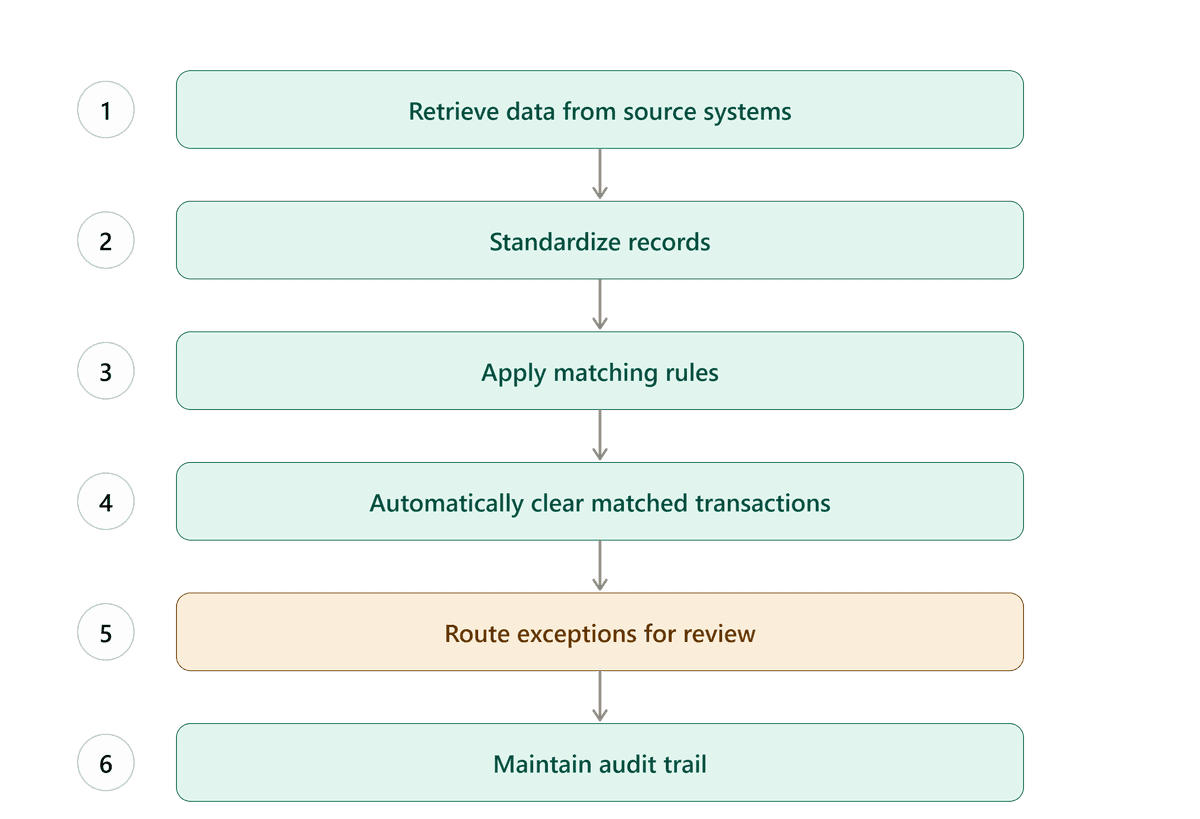
Transactions that satisfy the matching criteria can be automatically reconciled. Records that fall outside defined tolerances are treated as exceptions and routed for investigation.
This allows the organization's existing systems to continue performing their core functions while an automation layer coordinates the reconciliation process between them.
For organizations with significant ERP investments, this can provide a path toward finance automation without requiring a large-scale core system replacement.
Which Reconciliation Processes Can Be Automated?
A wide range of finance reconciliation activities can be automated, although the level of automation depends on data quality, process consistency, business rules, and system accessibility.
Bank reconciliation can automate the matching of bank transactions against general ledger entries and identify unmatched deposits, withdrawals, fees, or other discrepancies.
Accounts receivable reconciliation can compare invoices, payments, credit notes, deductions, and outstanding balances to improve cash application and exception management.
Accounts payable reconciliation can compare purchase orders, invoices, receipts, and payment records to identify missing or inconsistent information.
Billing reconciliation can validate invoices against pricing rules, contracts, usage information, and other source data before invoices are issued.
Intercompany reconciliation can compare transactions between legal entities and identify differences before financial close.
General ledger reconciliation can help finance teams validate balances and supporting transactions across accounts as part of the month-end close process.
The right starting point depends less on whether a process can technically be automated and more on whether the underlying process and data are ready for automation.
Where Can AI Improve Reconciliation Beyond Rule-Based Matching?
Traditional reconciliation automation works particularly well when data is structured and matching rules can be clearly defined.
AI becomes valuable when the information being reconciled is less predictable.
Contracts are a good example. Customer agreements may contain pricing information, escalation clauses, discounts, exceptions, and other commercial terms in different formats and locations. Validating an invoice against these documents can require employees to read and interpret the underlying contract rather than simply compare two database fields.
AI and document intelligence can extract relevant information from contracts, invoices, and other semi-structured documents and convert it into data that can participate in an automated reconciliation workflow.
AI can also help identify likely matches where records do not align exactly, classify exceptions, detect unusual patterns, and provide finance teams with information that accelerates investigation.
The strongest applications typically combine AI with deterministic financial controls. AI helps interpret complex information, while defined business rules, tolerances, workflows, and human approvals provide the governance required for financial operations.
Reconciliation Automation in Practice: From Contracts to Invoice Validation
The value of this approach becomes clearer in a real-world billing environment.
A U.S.-based print and mail enterprise serving more than 5,000 customers was managing customer contracts with inconsistent structures, complex pricing arrangements, rate changes, and semi-structured information. Manually validating invoices against the relevant contractual terms required significant finance effort and created the risk of pricing discrepancies.
LOWCODEMINDS implemented an AI-powered billing and contract reconciliation engine that extracted key contract terms, compared them against invoice line items, and automatically identified pricing and term mismatches before invoices were issued.
The organization achieved 99% invoice accuracy and an 80% reduction in manual reconciliation effort, while real-time mismatch detection helped finance teams address discrepancies earlier in the billing cycle.
Read the billing and contract reconciliation case study
The example illustrates an important distinction. Reconciliation automation does not have to be limited to matching identical fields across two structured datasets. AI can help extend reconciliation into areas where important financial information exists inside contracts, documents, and other semi-structured sources.
Should You Automate Reconciliation Immediately or Standardize the Process First?
Not every manual reconciliation process should be automated in its current form.
If different employees follow different procedures, reconciliation rules are undocumented, source data is inconsistent, or important business logic exists primarily in employees' knowledge, immediately automating the process can reproduce existing inefficiencies in a new technology layer.
In these situations, process standardization should come first.
Organizations should establish which systems are authoritative, document reconciliation rules and tolerances, define exception categories, clarify ownership, and determine how different types of discrepancies should be resolved.
Once this operating model is consistent, automation becomes significantly easier to design, govern, and scale.
LOWCODEMINDS encountered this situation during a finance process transformation engagement involving accounts payable, accounts receivable, general ledger, billing, and month-end close activities.
The organization relied heavily on individual knowledge and had limited process documentation or standardization. More than 180 detailed working instructions were created as part of the transformation, enabling over 90% process standardization and establishing a foundation for future automation and AI-driven reconciliation.
The transformation also reduced the billing cycle from seven business days to approximately 2.5 to three days and reduced month-end close from 12–14 business days to five days, representing an approximately 60% reduction in both cycles.
See how finance process transformation improved billing and month-end close
This highlights an important principle for finance leaders: automate a well-defined process rather than simply digitizing an inconsistent one.
How to Automate Reconciliation Without Replacing Your ERP
One misconception about reconciliation automation is that the organization's core finance technology must first be modernized or replaced. In many cases, it does not.
Enterprises often have substantial investments in ERP, billing, banking, CRM, and other financial systems that continue to perform their intended functions effectively. The problem is the manual work required between those systems.
Rather than replacing the systems of record, organizations can introduce an automation and process orchestration layer that connects them.
APIs, database integrations, file-based exchanges, robotic automation, workflow technologies, AI, and document intelligence can be combined depending on the existing environment.
This approach allows finance organizations to modernize a specific process while preserving investments in core enterprise platforms.
It can also enable organizations to automate incrementally. A high-volume reconciliation process can be addressed first, followed by additional finance workflows as the operating model matures.
How to Identify the Right Reconciliation Processes to Automate First
The best candidate is not necessarily the reconciliation process consuming the most employee hours.
Finance leaders should consider several factors together.
Processes with high transaction volumes and repetitive matching rules usually provide strong opportunities because a large percentage of transactions may be cleared automatically.
Processes with high exception rates can also be valuable targets, particularly when employees repeatedly perform similar investigations.
The financial impact of errors matters as well. Reconciliations connected to customer billing, revenue recognition, cash application, or financial reporting may justify greater priority because errors can directly affect cash flow or reporting accuracy.
Data accessibility is another important consideration. Automation becomes easier when the required information can be reliably retrieved from source systems.
Finally, organizations should evaluate process maturity. A highly manual but standardized reconciliation process may actually be easier to automate than a smaller process governed by undocumented rules and individual judgment.
A useful automation assessment therefore considers volume, manual effort, exception rates, financial risk, process standardization, and data availability together.
What Business Impact Can Reconciliation Automation Deliver?
The most visible benefit is a reduction in manual effort, but the business case can extend considerably further.
Automated matching can shorten reconciliation cycles because transactions no longer need to wait for employees to review them individually. Earlier exception identification gives teams more time to investigate discrepancies before they affect downstream processes.
Improved validation can reduce billing errors, duplicate transactions, incorrect postings, and other financial inaccuracies. Structured workflows can also strengthen auditability by maintaining consistent records of matches, exceptions, approvals, and corrections.
For finance leadership, automation can improve scalability. Transaction volumes can grow without requiring reconciliation headcount to increase at the same rate.
Most importantly, finance employees can spend less time comparing records and more time investigating material exceptions, analyzing financial performance, and supporting business decisions.
Moving From Manual Reconciliation to Exception-Based Finance Operations
The bigger opportunity in reconciliation automation is not simply completing the same activity faster. It is changing how finance work is organized.
In a traditional manual model, employees spend much of their time reviewing transactions to determine whether something is wrong. In an exception-based model, technology performs routine comparisons continuously and brings potentially problematic transactions to employees.
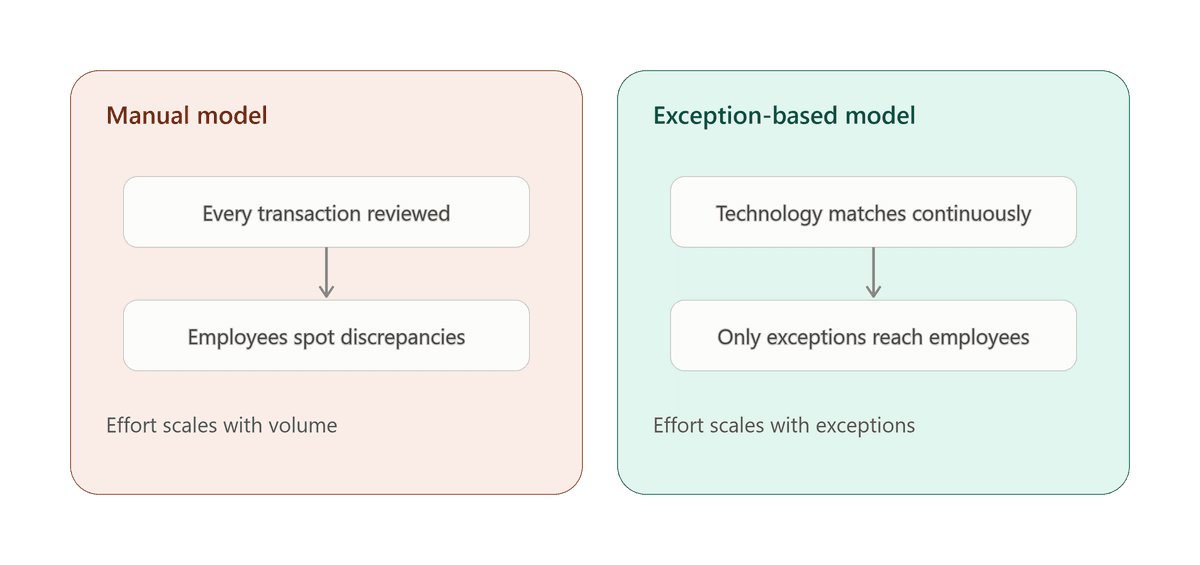
Finance professionals therefore spend less time searching for discrepancies and more time resolving the discrepancies that matter.
For enterprises operating across multiple ERP, billing, banking, payment, and financial systems, this can become an important part of broader finance transformation.
LOWCODEMINDS helps organizations identify high-friction finance processes, standardize workflows where required, integrate existing enterprise systems, and apply automation and AI to reconciliation, billing, and other finance operations without forcing unnecessary replacement of core systems.
Organizations evaluating where reconciliation automation could deliver the greatest operational or financial impact can reach LOWCODEMINDS at [email protected].
Reconciliation automation uses software, workflow automation, integration, and in some cases AI to compare financial records across systems, automatically match transactions, identify discrepancies, and route exceptions for investigation. It reduces the need for finance teams to manually review every transaction.
Common manual reconciliation challenges include fragmented data across systems, high transaction volumes, inconsistent data formats, time-consuming exception investigation, spreadsheet and data-entry errors, limited audit trails, and delays to billing or month-end close.
Yes. Reconciliation automation can often be implemented as an integration and process orchestration layer across existing ERP, billing, banking, payment, and other financial systems. This allows organizations to automate reconciliation while retaining their core systems of record.
Common candidates include bank reconciliation, accounts receivable reconciliation, accounts payable reconciliation, billing reconciliation, intercompany reconciliation, payment reconciliation, and general ledger account reconciliation.
AI can help extract information from invoices, contracts, statements, and other semi-structured documents, identify likely matches, classify exceptions, detect anomalies, and assist with discrepancy investigation. Financial controls and human oversight should remain part of the workflow where appropriate.
Exception-based reconciliation is an operating model in which technology automatically matches and clears routine transactions while finance employees focus on records that fail matching rules or require investigation. This reduces the amount of manual review required as transaction volumes grow.
In many cases, yes. If reconciliation rules are inconsistent, processes are undocumented, or outcomes depend heavily on individual knowledge, organizations should standardize the process before automating it. Well-defined rules, ownership, data sources, and exception procedures make reconciliation automation easier to govern and scale.
Potential benefits include lower manual effort, faster reconciliation cycles, fewer errors, earlier discrepancy detection, stronger audit trails, faster billing and financial close, and greater scalability as transaction volumes increase.
LOWCODEMINDS is a global leader in AI-led enterprise process orchestration and Knowledge Work Automation, transforming fragmented workflows into orchestrated, AI-driven decision systems that help enterprises modernize and scale business operations. Recognized as a Top Player and Contender in the ISG Provider Lens® Intelligent Automation Services 2025 (U.S.) study, the company is at the forefront of next generation automation and enterprise transformation.
LOWCODEMINDS helps enterprises transform knowledge intensive and compliance heavy enterprise value chains through trusted, governed, and scalable AI automation that delivers measurable operational and financial outcomes. Powered by App Labs, its dedicated innovation division, the company has developed 7+ Enterprise Value Chain Frameworks, 20+ reusable Agentic AI Accelerators, and 18+ enterprise ready solutions across industries including BFSI, Legal, Manufacturing, Retail, CCM, and Telecommunications.

Headquarters:
8, The Green Ste B, Dover, DE 19901.
[email protected]
(276) 451-3607
2026
LOWCODEMINDS | Privacy Policy