How to Reduce Production Delays in Manufacturing

How to Reduce Production Delays in Manufacturing with Better Production Scheduling
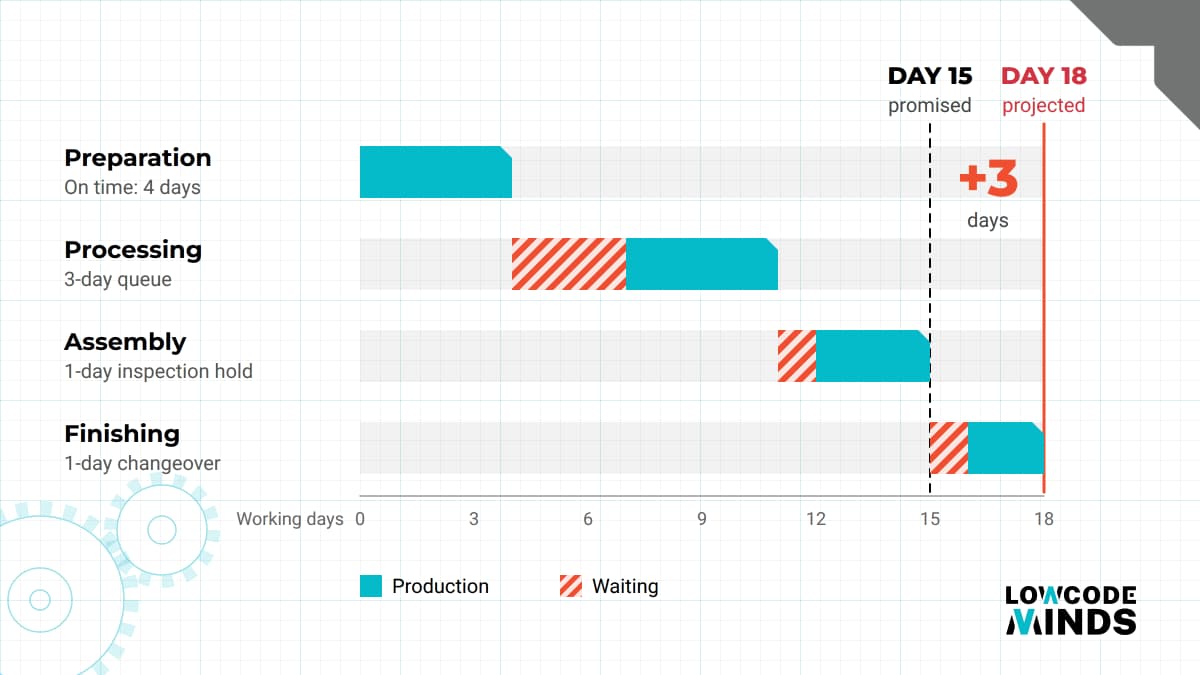
A manufacturer commits to delivering 5,000 units in 15 working days. The production team has checked the schedule, the machines are available, and the first stage can complete its work within four days. There is no obvious reason to question the delivery date.
But that commitment is based on what the first stage can deliver, not necessarily what the entire factory can complete.
The second stage already has two large orders in progress. Materials for another operation are awaiting inspection, and the finishing department has a planned changeover. None of these constraints is unusual. They are part of everyday manufacturing operations.
The problem is that their combined impact was not visible when the delivery date was confirmed.
By the time the order reaches the second stage, it has already lost several days. Planning now has to find capacity, rearrange other jobs and work out which customer commitments will be affected. What looked like a manageable 15-day order is now expected to take 18 days.
For manufacturers running multiple production stages, this is often where delivery performance begins to deteriorate. Individual departments may be meeting their production targets, but the overall order is still late.
The obvious response is to improve scheduling. Yet many manufacturers already have an ERP, production planning processes and experienced planners who understand their factory.
So why does the problem continue?
Because the schedule used to commit a delivery date is not always connected to the capacity, material availability and production dependencies that determine whether the factory can actually meet it.
The Production Plan Looks Fine. So Why Is the Order Late?
In many manufacturing operations, each department plans around its own capacity and priorities. Preparation schedules the work it can complete, processing plans against available machines, and finishing organizes jobs around its production targets and changeovers.
There is nothing inherently wrong with departmental planning. The difficulty is that an order must move through all these stages before it can be delivered.
Consider a plant where preparation can complete 1,500 units a day, but processing can handle only 1,000. If preparation continues producing at full capacity, unfinished work begins accumulating ahead of processing. The first department may report excellent utilization, but the factory is not necessarily completing customer orders any faster.
This is one reason manufacturers can have high machine utilization and still struggle with on-time delivery.
Material readiness creates another complication. A production line may be available on Monday, but the required materials may not clear inspection until Wednesday. If that information sits in an email thread or a separate spreadsheet, the schedule may continue to show the order as ready to begin.
By the time the conflict is identified, planners must find another job for the available line, adjust the sequence and inform the departments affected by the change.
The same problem appears when a machine breaks down or an urgent order is introduced. Rescheduling one department is relatively straightforward. Understanding what that change means for every subsequent stage, and for other orders competing for the same resources, is considerably harder.
These problems become more difficult as manufacturers add production stages, shared equipment, product variations and customer commitments.
The issue is not necessarily that planning teams are making poor decisions. They may simply be making those decisions without a reliable view of the entire production route.
Better Production Scheduling Starts with the Entire Manufacturing Route
For manufacturers trying to reduce production delays, the first improvement is to evaluate whether an order can move through every required production stage within the committed timeframe.
That means looking beyond when a job can start.
A realistic production schedule must account for material readiness, available machines, operating calendars, production rates, changeovers and the dependencies between different operations.
This is where finite capacity scheduling becomes relevant.
Instead of allocating work without fully accounting for resource limitations, finite capacity scheduling considers the capacity actually available. It helps planners identify when two orders are competing for the same machine, whether a changeover affects the next job, and how delays in one stage may influence the remaining production route.
Return to the manufacturer that committed to delivering 5,000 units in 15 days.
The first department may genuinely have the capacity to complete its work within four days. But a route-wide schedule could reveal that processing is already committed to two other orders, while finishing has limited availability later in the week.
With those constraints considered, the expected completion date moves to day 18.
That information is much more useful before the customer commitment is made than after the order has entered production.
The planning team can evaluate whether another eligible machine is available, whether the production sequence can be changed or whether additional shifts would make the original delivery date achievable. If those options are not feasible, the business can agree on a more realistic date with the customer.
There is also an important distinction between generating a feasible schedule and choosing the best schedule for the business.
A plant may have several possible production sequences, each with different consequences. Prioritizing one order might protect a contractual commitment but delay another customer. Grouping similar products could reduce changeover time while pushing back an urgent delivery.
Scheduling logic can help planners compare these alternatives, but the final decision may require commercial context that the system does not have.
Planners need to understand why a job is scheduled at a particular time, what is preventing it from starting earlier and what happens if its priority changes.
A better scheduling process should make those trade-offs visible rather than simply producing a revised list of jobs.
When Production Changes, the Entire Plan Needs to Respond
Even a well-prepared production schedule will encounter disruptions. A material shipment may arrive late, a quality inspection may place a batch on hold, or actual output may fall below the planned quantity.
The question is how quickly the organization can understand the impact and respond.
Consider a material inspection that delays the release of a critical component by two days.
In a plant where procurement, planning and production operate through separate systems and spreadsheets, the inspection team may inform procurement, which then informs planning. Planners identify the affected orders, check alternative capacity, revise the sequence and communicate the changes to individual departments.
Meanwhile, other teams may still be working from the previous schedule.
The original material problem may be unavoidable. The additional time spent discovering its impact and coordinating the response is where manufacturers have an opportunity to improve.
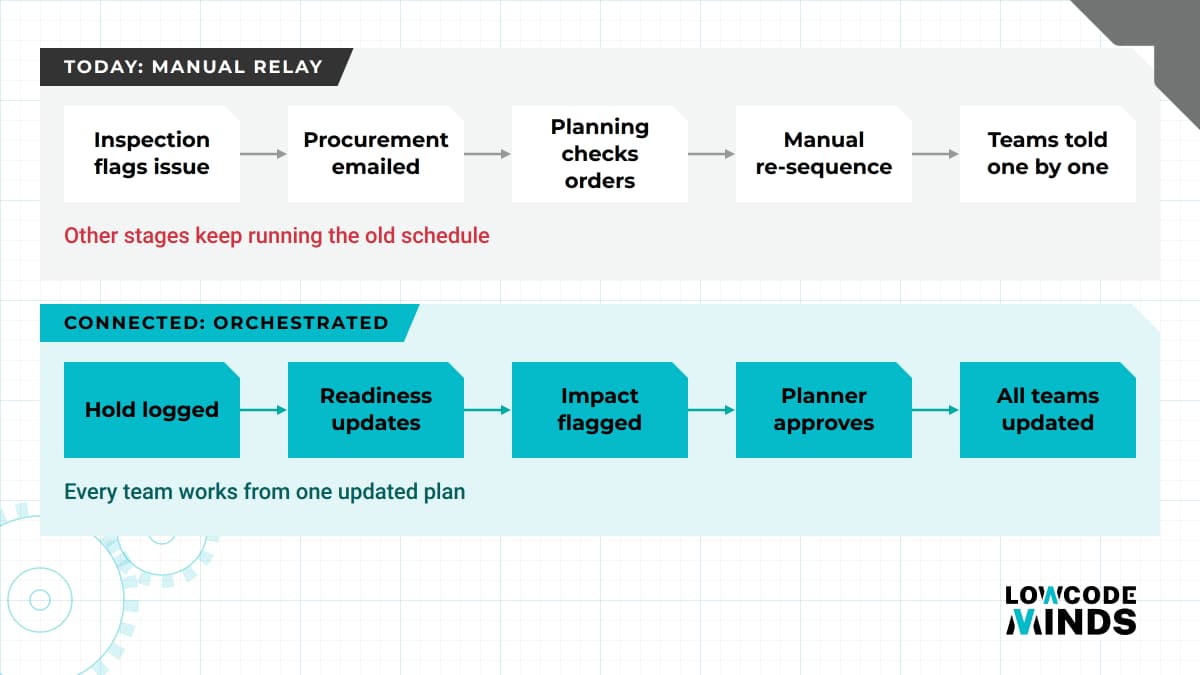
In a connected environment, the material hold can update the order's readiness status in the relevant system. That change can initiate a scheduling review to identify which jobs can no longer start as planned and which downstream operations may be affected.
The scheduling capability can evaluate alternative sequences using the available capacity and production constraints. Planners can then review the options, consider the effect on customer commitments and approve an appropriate response.
Once a decision is made, the revised plan can be reflected in the relevant systems and communicated to the teams responsible for execution.
This is where process orchestration becomes important to production planning.
Scheduling logic determines what production sequences are feasible. Process orchestration helps coordinate the information, system updates, exceptions and human approvals needed to act on those decisions.
The same principle applies to actual production output.
Suppose a line completes 800 units during a shift against a planned output of 1,000. If that shortfall remains in a departmental report until the next planning meeting, subsequent operations may continue using assumptions that are no longer accurate.
When shop-floor progress is connected to scheduling, the remaining production requirement can be updated and the downstream impact evaluated sooner.
Manufacturers do not need every change to trigger a complete replanning exercise. Some variations can be absorbed within the existing schedule, while others require intervention. The process should distinguish between routine updates and exceptions that genuinely threaten delivery commitments.
That distinction matters because the objective is not to generate more alerts or constantly revise schedules. It is to give planners the information they need to act before a manageable disruption becomes a missed delivery date.
Improving Production Scheduling Without Replacing Your ERP
For CIOs and CTOs, one of the practical questions is whether improving production scheduling requires another major enterprise software implementation.
Not necessarily.
Many manufacturers already have important pieces of the solution in place. Their ERP manages customer orders, materials, inventory and production requirements. An MES or another shop-floor system may capture job status and actual output. Some organizations also have advanced planning and scheduling capabilities, while others rely on departmental tools and spreadsheets.
The problem is often how these capabilities work together.
ERP platforms differ considerably in their scheduling functionality. Some support detailed capacity planning, while others rely on separate scheduling applications. Advanced Planning and Scheduling (APS) systems can help optimize production sequences and resource allocation, but their effectiveness also depends on timely information about materials, capacity and actual production progress.
A manufacturer therefore needs to establish what is missing before deciding whether to introduce a new platform.
| Existing capability | What it contributes |
|---|---|
| ERP / MRP | Customer orders, materials, inventory and production requirements |
| APS or scheduling logic | Capacity-constrained scheduling, sequencing and evaluation of alternatives |
| MES or shop-floor reporting | Actual production output, job status and operational events |
| Workflow orchestration | Coordination of exceptions, approvals, notifications and updates across systems |
| Planner interface | Visibility into constraints, scheduling alternatives and decisions requiring review |
For some plants, the priority may be introducing a dedicated scheduling capability. For others, the scheduling functionality may already exist, but material updates, production exceptions and approval decisions are not flowing reliably between systems.
The latter is an integration and process coordination problem as much as a scheduling problem.
A connected approach allows the ERP to remain the system of record while scheduling and execution-related information moves between the relevant applications. When a material delay or capacity conflict occurs, the appropriate review can be initiated without relying entirely on emails and manual follow-ups.
This is also the role of enterprise process orchestration: connecting activities, systems and human decisions across an end-to-end business process.
The right architecture depends on the existing technology environment, production complexity and quality of available data. A manufacturer with relatively straightforward production routes may not need the same scheduling capabilities as a plant managing hundreds of competing jobs, shared resources and frequent changeovers.
The starting point should be an assessment of the current planning process, not an assumption that another application will solve the problem.
Where Does AI Fit into Production Scheduling?
AI can contribute to production planning, but it is important to separate what requires AI from what can already be achieved through scheduling optimization and workflow automation.
For example, determining whether a machine has sufficient capacity to process an order is fundamentally a scheduling and constraint-management problem. A suitable optimization approach can handle that without requiring generative AI.
AI becomes more relevant when manufacturers want to make better use of historical and operational data.
Production records may reveal that certain products consistently take longer than their standard processing times suggest. Predictive models can help estimate more realistic completion times under different operating conditions.
Similarly, information about material readiness, production progress and historical delays may help identify orders that are at risk of missing their delivery dates.
AI-supported analysis can also help investigate recurring scheduling exceptions or evaluate complex alternatives, provided the models are appropriate for the task and operate within the required production constraints.
However, these capabilities depend on reliable data.
If a manufacturer is still struggling to obtain accurate material status or timely shop-floor updates, connecting those sources may be more valuable initially than adding an AI model.
The priority should be to improve the quality and speed of production decisions, using AI where it provides a demonstrable advantage.
What Should Manufacturers Measure?
A production scheduling improvement should ultimately be judged by its impact on operations and customer commitments.
On-time delivery is an obvious starting point, but it should not be the only measure. Manufacturers should also examine whether production lead times are improving, whether work-in-progress is accumulating between stages and how closely actual production follows the approved schedule.
The time planners spend building and revising schedules is another useful measure, particularly where manual coordination is consuming substantial effort.
Changeover hours and capacity utilization can help explain the operational trade-offs behind different scheduling decisions.
These measures need to be considered together. A department operating at maximum utilization may appear efficient, but not if its output creates excessive WIP ahead of a downstream bottleneck. Similarly, reducing changeovers may be useful, but not at the expense of an important delivery commitment.
The aim is to improve how the complete manufacturing route performs, rather than making individual departmental metrics look better.
Where Should Manufacturers Start?
A manufacturer does not need to redesign production planning across every facility to begin addressing these problems.
A more manageable starting point is to examine one production route, product family or facility where delivery delays are recurring.
Follow a typical customer order from the point of commitment through each production stage. Identify where it waits, where schedules are updated manually, which resources regularly constrain throughput and how teams respond when materials or production output differ from the plan.
Then examine the information already available in the ERP, shop-floor systems and planning tools.
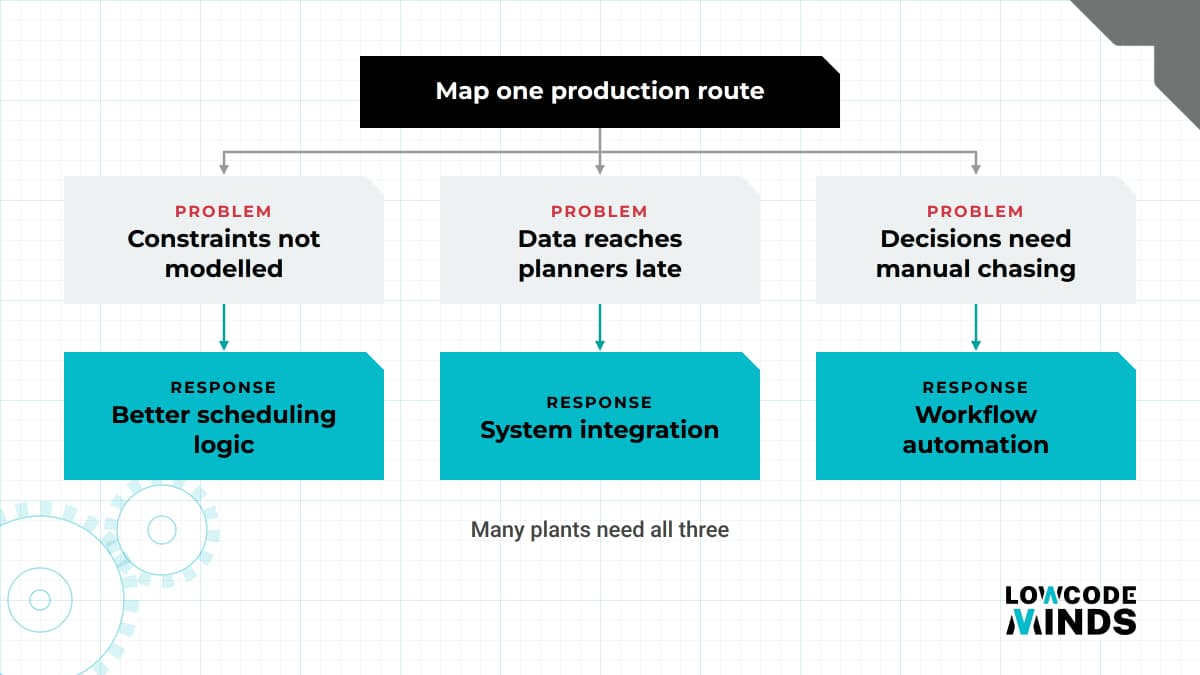
This usually helps separate three different problems: scheduling constraints that are not adequately modeled, operational information that does not reach planners in time, and decisions or approvals that depend on manual coordination.
Each requires a different response.
A capacity problem may call for better scheduling logic. Delayed operational information may require system integration. Repeated manual follow-ups may be addressed through workflow automation. Some environments will require a combination of all three.
Once the most important gaps are identified, manufacturers can define a focused improvement initiative and measure its effect on schedule adherence, planning effort and on-time delivery before extending the approach elsewhere.
The objective is not to automate every planning activity immediately. It is to address the constraints and coordination gaps that are having the greatest impact on delivery performance.
Reducing Production Delays Requires More Than a Better Schedule
Manufacturers can invest heavily in improving individual machines and production departments while continuing to struggle with delivery commitments.
The reason is that customer orders do not move through a factory one department at a time in isolation. Their completion depends on the availability of materials, capacity across multiple stages, production sequencing and the decisions made when circumstances change.
Better production scheduling helps manufacturers understand these dependencies and establish realistic commitments. Connecting scheduling with operational systems and workflows helps ensure that changes are recognized and acted upon before they create further delays.
For manufacturers already operating ERP and shop-floor systems, that may be a more practical starting point than replacing existing applications or adding technology without first understanding where the process is breaking down.
Looking to Reduce Production Delays Across Your Manufacturing Operations?
If your production teams are constantly revising schedules, managing capacity conflicts or struggling to keep delivery commitments, it may be worth examining how planning and execution are connected across your existing systems.
At LOWCODEMINDS, we help enterprises improve complex operations through process design, enterprise system integration, workflow automation and AI where it serves a clear business purpose.
For manufacturers, this can mean connecting operational information, coordinating decisions across departments and reducing the manual effort involved in responding to production exceptions.
Let's discuss your production planning challenges.
Email [email protected] or contact LOWCODEMINDS.
Manufacturers can reduce avoidable production delays by accounting for material readiness, actual capacity and dependencies across production stages when scheduling orders. Connecting the schedule with shop-floor progress also helps planning teams identify disruptions and coordinate responses before they affect customer commitments.
An ERP may contain accurate order, inventory and material information, but detailed scheduling, production updates and exception handling may still be managed separately. When these activities are not connected, changes in capacity or material readiness may not be reflected quickly enough in production plans.
Yes. Manufacturers can integrate scheduling capabilities, shop-floor data and workflow automation with their existing ERP. The appropriate approach depends on the ERP's current functionality and the operational gaps that need to be addressed.
Finite capacity scheduling creates production sequences based on available resources and operational constraints. Process orchestration coordinates the information, approvals and system updates needed to respond to scheduling decisions and production changes across departments.
AI can support on-time delivery by helping predict production completion times, identify orders at risk of delay and analyze operational patterns. Its effectiveness depends on the quality of available data and how its recommendations are incorporated into production planning decisions.
Not necessarily. A financial institution can first assess where its existing monitoring process is struggling and determine whether AI can strengthen areas such as behavioural analysis, alert prioritisation, investigation or workflow orchestration.
Fraud analysts need to understand why activity was flagged and what information contributed to an assessment. Recording that reasoning also helps financial institutions review decisions through their governance and audit processes.
A practical starting point is the existing end-to-end fraud monitoring and investigation process. Reviewing false positives, alert quality, investigation time, analyst effort, customer interventions and governance requirements can help identify where AI is likely to create useful business value.
About the Author

Hirushiharan Thevendran
Hirushiharan Thevendran is a Senior Software Engineer specializing in AI-driven automation, with around five years of experience designing and developing enterprise applications. His expertise spans workflow automation and agentic AI, with a focus on solving complex business challenges.
A Claude Certified Architect, Hirushiharan focuses on building scalable applications and translating emerging AI technologies into practical solutions that improve business processes and operational efficiency.
LOWCODEMINDS is a global leader in AI-led enterprise process orchestration and Knowledge Work Automation, transforming fragmented workflows into orchestrated, AI-driven decision systems that help enterprises modernize and scale business operations. Recognized as a Top Player and Contender in the ISG Provider Lens® Intelligent Automation Services 2025 (U.S.) study, the company is at the forefront of next generation automation and enterprise transformation.
LOWCODEMINDS helps enterprises transform knowledge intensive and compliance heavy enterprise value chains through trusted, governed, and scalable AI automation that delivers measurable operational and financial outcomes. Powered by App Labs, its dedicated innovation division, the company has developed 7+ Enterprise Value Chain Frameworks, 20+ reusable Agentic AI Accelerators, and 18+ enterprise ready solutions across industries including BFSI, Legal, Manufacturing, Retail, CCM, and Telecommunications.

Headquarters:
8, The Green Ste B, Dover, DE 19901.
[email protected]
(276) 451-3607
2026
LOWCODEMINDS | Privacy Policy