Telecom Site Management Software: Complete Guide

Telecom Site Management Software: How to Manage Assets, Vendors, Maintenance, and Site Operations
Managing telecom sites becomes harder as the network grows, not simply because there are more sites, but because there is more information, more equipment, more vendors, more maintenance activity, and more coordination required across every location.
Asset records may sit in one system. Maintenance schedules may be managed elsewhere. Vendor SLAs may live in spreadsheets. Incidents may be reported through emails or separate ticketing systems. New site development may have its own project trackers and approval processes.
Each process may work independently, but the bigger operational challenge is connecting them.
Telecom site management software provides a centralized platform for managing telecom sites, assets, vendors, tenants, incidents, maintenance, and site development. It gives operators and infrastructure providers a more complete view of each site while helping teams coordinate the workflows required to keep telecom infrastructure operational.
For telecom operators, TowerCos, infrastructure providers, and service providers managing distributed site portfolios, that visibility becomes increasingly important as operations scale.
What Is Telecom Site Management Software?
Telecom site management software is used to manage the operational and infrastructure activities associated with telecom sites through a centralized system.
Depending on the organization, this can include:
- Telecom towers and sites
- Network equipment and other site assets
- Power systems, generators, and utilities
- Vendors and service providers
- Tenants and site resources
- Incidents and service requests
- Preventive and corrective maintenance
- New site development
- Site documentation and operational data
- Reporting and analytics
Rather than treating these as separate activities, a site management platform connects them around a common record of the telecom site.
For example, teams should be able to see which assets are located at a particular site, which vendor supports them, what maintenance has been completed, whether incidents have occurred, and what actions are currently outstanding without having to reconstruct the information from multiple systems.
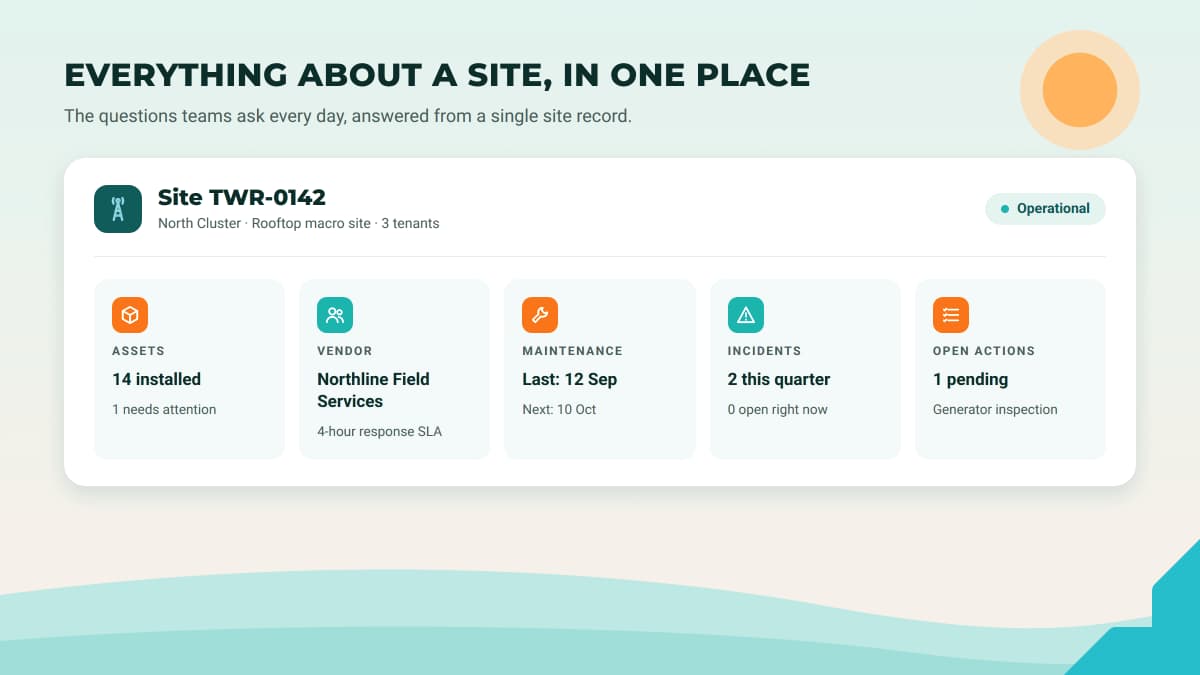
Why Telecom Site Operations Become Difficult to Manage
The complexity of telecom site management usually builds gradually.
An organization may start with spreadsheets for asset records, email for vendor coordination, another application for incidents, and separate trackers for maintenance. As the site portfolio expands, more processes and systems are added.
Eventually, teams can spend significant time simply finding the right information.
This can create practical problems across operations.
An incident may be reported without complete visibility into previous failures at the site. A maintenance team may not have the latest asset information. Vendor performance may be difficult to compare against agreed SLAs. Management may have limited visibility into maintenance activity across the overall portfolio.
The issue is not necessarily that information does not exist.
The issue is that the information needed to operate a telecom site is often fragmented across different processes, systems, and teams.
Telecom site management software is intended to bring those activities into a more connected operating environment.
What Should Telecom Site Management Software Help You Manage?
Organizations evaluating telecom site management software should look beyond basic site records or asset inventories.
A site management platform becomes more valuable when it supports the different operational processes that take place throughout the lifecycle of a telecom site.
1. Create a Centralized View of Sites and Assets
A telecom site can contain multiple types of infrastructure, including network equipment, generators, utilities, power systems, and other physical assets.
When asset information is maintained across separate files and systems, answering basic operational questions can become unnecessarily difficult.
What equipment is installed at this site? What is its current status? When was it last maintained? Has the asset been involved in previous incidents? Who is responsible for supporting it?
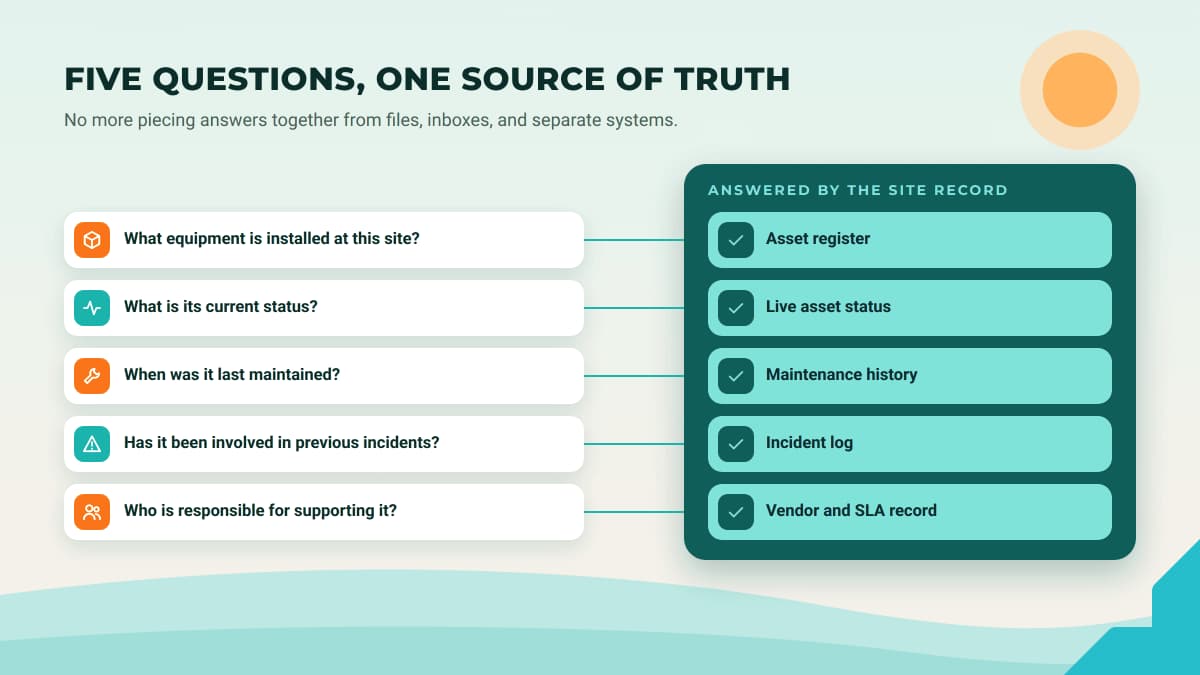
A telecom site management system should maintain a structured record of sites and the assets associated with them.
This gives operations teams a clearer view of infrastructure across individual locations as well as the wider site portfolio.
Asset information can then support other processes such as maintenance, incident management, vendor coordination, and lifecycle planning.
2. Manage Vendors and SLAs Across Sites
Telecom operations often depend on multiple external vendors and service providers.
Different companies may be responsible for equipment installation, field maintenance, utilities, repairs, inspections, or other services across different locations.
Managing these relationships becomes considerably harder when vendor information, contracts, site assignments, and service-level agreements are maintained separately from site operations.
Telecom site management software can connect vendors with the sites and activities they support.
Teams can maintain information about vendor responsibilities, contracts, SLAs, performance, and site assignments within the same operational environment.
When an incident occurs, for example, the responsible service provider can be identified and the required response tracked against the appropriate SLA.
This creates a clearer connection between who is responsible for the work and what is actually happening at the site.
3. Coordinate Tenants and Site Resources
For TowerCos and infrastructure providers, a telecom site may support multiple tenants sharing infrastructure, utilities, and available space.
Managing this efficiently requires visibility into who is using the site and how resources are allocated.
A telecom site management platform can help maintain tenant information, agreements, site allocation, utilities, and associated resources.
This gives infrastructure teams a more consistent view of site utilization and makes it easier to coordinate shared infrastructure across the portfolio.
4. Automate Telecom Site Incident Management
When an incident occurs at a telecom site, speed matters.
But resolution can slow down when reporting, assignment, escalation, vendor coordination, and status updates depend heavily on manual communication.
A site management system can provide a structured workflow from incident capture through resolution.
An incident can be associated with the relevant site and asset, automatically routed to the appropriate team or vendor, prioritized according to predefined rules, and tracked until it is resolved.
Notifications and escalations can also be automated so that unresolved issues do not depend entirely on someone manually following up.
Importantly, the incident becomes part of the site's operational history.
Over time, teams can identify whether the same asset or site is experiencing repeated issues rather than treating every incident as an isolated event.
5. Move from Reactive to Proactive Site Maintenance
Maintenance is another area where disconnected processes can create unnecessary operational effort.
If maintenance schedules are maintained separately from asset information and incident history, teams may have limited context when planning work.
Telecom site management software can connect these records.
Routine maintenance can be scheduled according to defined intervals. Teams and vendors can be assigned automatically. Completion can be recorded against the relevant asset or site, creating an ongoing maintenance history.
Operational and historical data can also help teams identify assets that require greater attention.
Where sufficient data is available, predictive analytics can support a more proactive maintenance approach by identifying patterns that may indicate potential equipment issues.
The objective is not simply to schedule maintenance digitally. It is to make maintenance part of a connected asset and site management process.
6. Manage New Telecom Site Development
Telecom site management does not begin when a site becomes operational.
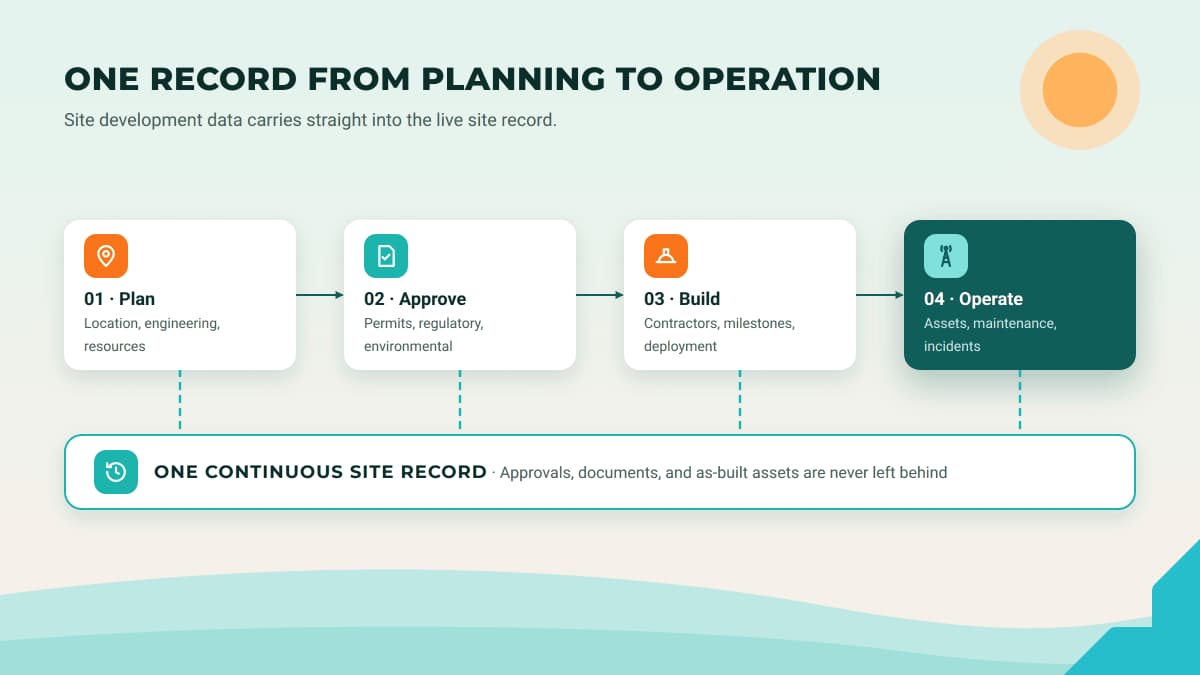
New site development can involve site planning, engineering, contractors, resource allocation, approvals, regulatory requirements, environmental considerations, and multiple deployment milestones.
When these activities are managed through separate trackers and communication channels, it can be difficult to maintain a consistent view of progress.
A site management platform can provide structured workflows from planning through execution.
Teams can monitor milestones, responsibilities, resources, documentation, approvals, and project status while maintaining a clear record of the site's development.
Once the site becomes operational, the same information can become part of its ongoing site record rather than being left behind in a separate project system.
7. Use Site Data for Operational Decisions
Managing telecom infrastructure generates a significant amount of operational data.
The challenge is turning that information into something useful.
A telecom site management platform can provide dashboards and reports across areas such as:
- Site and asset status
- Incident volumes and resolution
- Maintenance activity
- Asset health
- Vendor performance
- SLA adherence
- Site utilization
- Development milestones
- Operational trends
Portfolio-level visibility is particularly important for organizations managing large numbers of geographically distributed sites.
Instead of reviewing individual trackers or requesting updates from multiple teams, operations leaders can identify areas that require attention from a common view.
Why a Unified Telecom Site Management Platform Matters
It is possible to digitize each telecom site process independently and still have fragmented operations.
An organization could have an asset management application, maintenance system, ticketing platform, vendor database, and project management tool, yet teams may still need to manually connect information between them.
The larger opportunity is therefore not simply digitization.
It is operational orchestration.
A unified telecom site management platform connects site information with the workflows that depend on it.
An incident can connect to an asset. The asset can connect to its maintenance history. Maintenance work can connect to the responsible vendor. Vendor activity can connect to an SLA. All of these can remain associated with the relevant telecom site.
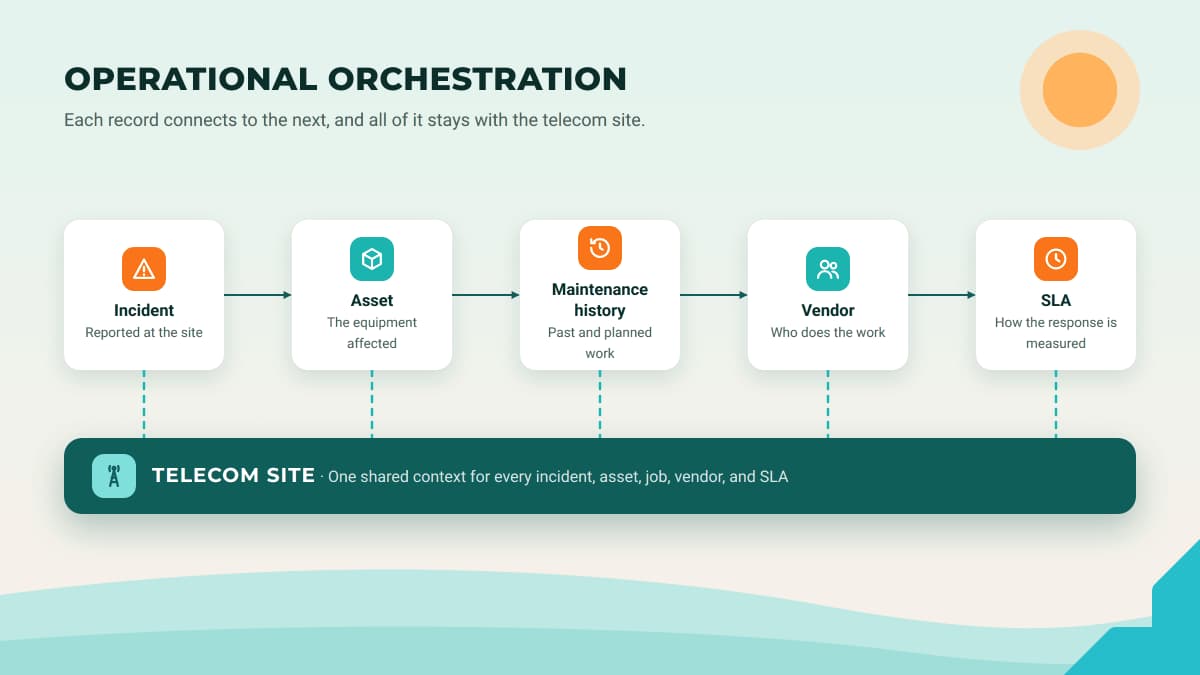
This creates operational context that is difficult to achieve when each process is managed independently.
For organizations looking to bring these activities together, the LOWCODEMINDS Tower and Site Management Solution provides a centralized platform for managing telecom assets and systems, vendors and tenants, new site development, incidents, maintenance, and operational data.
Explore the Tower and Site Management Solution →
What to Look for When Choosing Telecom Site Management Software
For buyers evaluating a telecom site management system, feature lists are useful, but they should not be the only consideration.
The platform also needs to fit the way the organization operates.
Ability to Manage Multiple Asset Types
The system should support the different equipment, infrastructure, utilities, and physical assets found across telecom sites rather than limiting teams to a narrow asset model.
Workflow Automation
Look for the ability to automate assignments, approvals, notifications, escalations, maintenance schedules, and other repetitive operational processes.
Vendor and Tenant Management
For organizations working with multiple service providers or tenants, these relationships should be connected to the sites, assets, and workflows they affect.
Incident and Maintenance Management
Incident reporting, resolution, maintenance scheduling, and asset history should work together rather than as separate processes.
Analytics and Reporting
Operations teams should be able to see both individual site information and trends across the wider portfolio.
Integration with Existing Systems
A telecom site management platform should work with the organization's existing technology environment.
Integration can help connect enterprise systems, operational applications, data sources, and third-party tools without requiring every existing system to be replaced.
Scalability
The platform should be capable of supporting growth in sites, assets, users, workflows, and operational data.
Ability to Adapt
Telecom operating models change. Processes, vendors, infrastructure, compliance requirements, and technologies evolve.
A platform that can be configured and extended as requirements change can reduce the need for repeated large-scale redevelopment.
When Should You Consider Replacing Disconnected Site Management Processes?
Not every organization needs to replace its existing processes simply because spreadsheets or multiple systems are involved.
The stronger signals appear when fragmentation begins affecting operations.
It may be time to consider a unified telecom site management platform when:
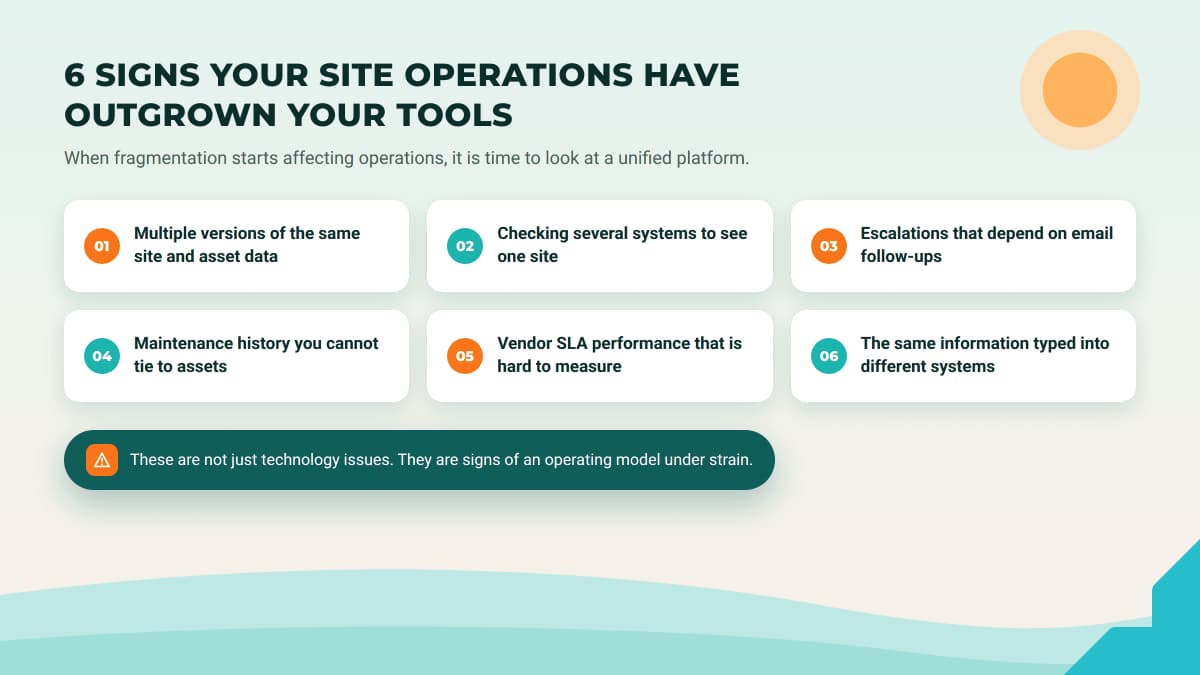
- Teams maintain multiple versions of site or asset information
- Getting a complete view of one site requires checking several systems
- Incident assignment and escalation rely heavily on emails or manual follow-ups
- Maintenance history is difficult to connect to individual assets
- Vendor SLA performance is difficult to monitor
- New site development relies on multiple independent trackers
- Management lacks portfolio-level visibility
- Teams repeatedly enter the same information into different systems
- Existing applications cannot easily adapt to new operational requirements
These are not simply technology issues. They are signs that the way site operations are managed may no longer match the scale or complexity of the infrastructure.
Bringing Telecom Site Operations Together
Telecom infrastructure will always involve multiple assets, vendors, teams, systems, and operational processes.
The question is whether those activities are managed as isolated pieces of work or as part of a connected site operation.
For telecom operators, TowerCos, infrastructure managers, and service providers, a unified platform can provide a clearer view of what is happening across sites while connecting asset management, vendor coordination, tenant management, incidents, maintenance, and site development.
LOWCODEMINDS' Tower and Site Management Solution is designed to bring these operations together on a centralized, scalable platform while integrating with existing systems and adapting to changing operational requirements.
Managing telecom sites across disconnected systems?
See how LOWCODEMINDS can help bring your telecom sites, assets, vendors, tenants, incidents, maintenance, and site operations together through a unified platform.
Telecom site management software is a platform used to manage telecom sites, infrastructure assets, vendors, tenants, incidents, maintenance, site development, and related operational workflows from a centralized system.
Telecom operators, TowerCos, telecom infrastructure providers, managed service providers, and other organizations responsible for operating distributed telecom sites can use site management software.
Telecom asset management focuses primarily on tracking and managing equipment and infrastructure throughout their lifecycle. Telecom site management is broader and can connect those assets with vendors, tenants, incidents, maintenance, site development, and other operational activities associated with each location.
Yes. A telecom site management platform can integrate with existing enterprise, operational, and third-party systems so organizations can connect site workflows and data without necessarily replacing their entire technology environment.
LOWCODEMINDS is a global leader in AI-led enterprise process orchestration and Knowledge Work Automation, transforming fragmented workflows into orchestrated, AI-driven decision systems that help enterprises modernize and scale business operations. Recognized as a Top Player and Contender in the ISG Provider Lens® Intelligent Automation Services 2025 (U.S.) study, the company is at the forefront of next generation automation and enterprise transformation.
LOWCODEMINDS helps enterprises transform knowledge intensive and compliance heavy enterprise value chains through trusted, governed, and scalable AI automation that delivers measurable operational and financial outcomes. Powered by App Labs, its dedicated innovation division, the company has developed 7+ Enterprise Value Chain Frameworks, 20+ reusable Agentic AI Accelerators, and 18+ enterprise ready solutions across industries including BFSI, Legal, Manufacturing, Retail, CCM, and Telecommunications.

Headquarters:
8, The Green Ste B, Dover, DE 19901.
[email protected]
(276) 451-3607
2026
LOWCODEMINDS | Privacy Policy