Telecom Tower Management Software: Complete Guide

Telecom Tower Management Software: What It Is, Key Features, and How It Works
Telecom towers are only one part of what operators and infrastructure providers have to manage across a growing site portfolio. Every site can include network equipment, power systems, utilities, physical infrastructure, vendors, tenants, maintenance schedules, incidents, contracts, and ongoing site development activities.
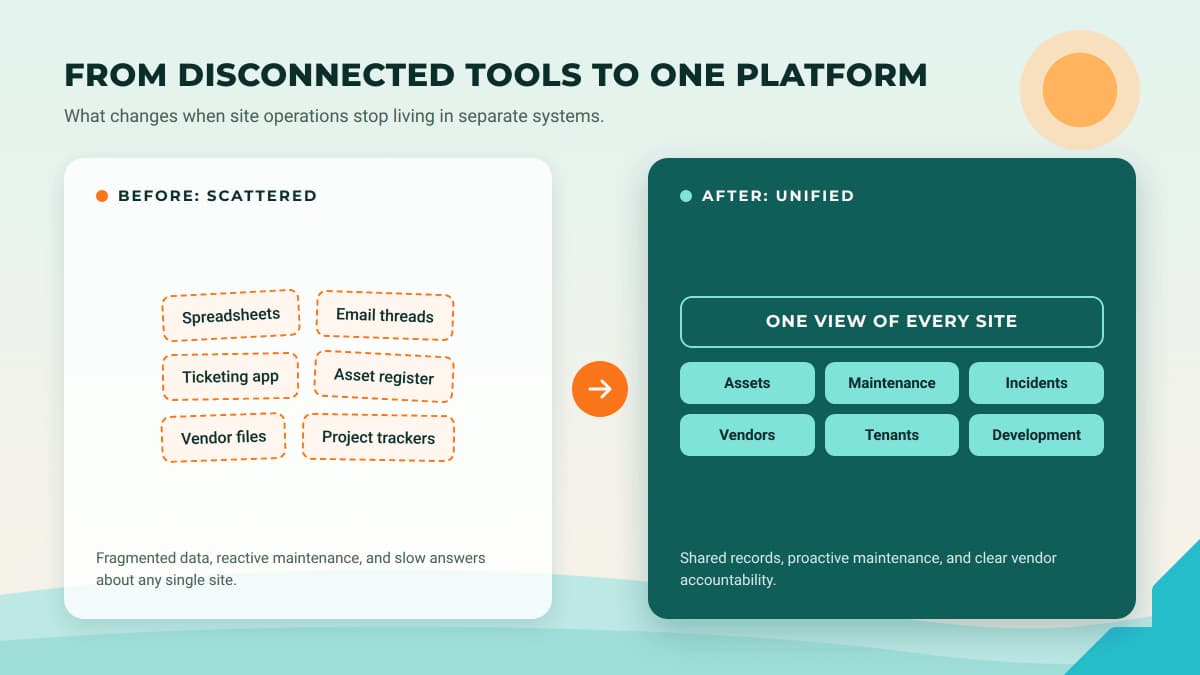
As the number of sites increases, managing all of this across spreadsheets, emails, disconnected applications, and individual teams becomes difficult to sustain. Information gets fragmented, maintenance becomes reactive, and getting a reliable view of what is happening at a particular site can take longer than it should.
Telecom tower management software brings these activities together so that operators, TowerCos, infrastructure providers, and service providers can manage their sites, assets, vendors, tenants, incidents, and maintenance from a more connected environment.
What Is Telecom Tower Management Software?
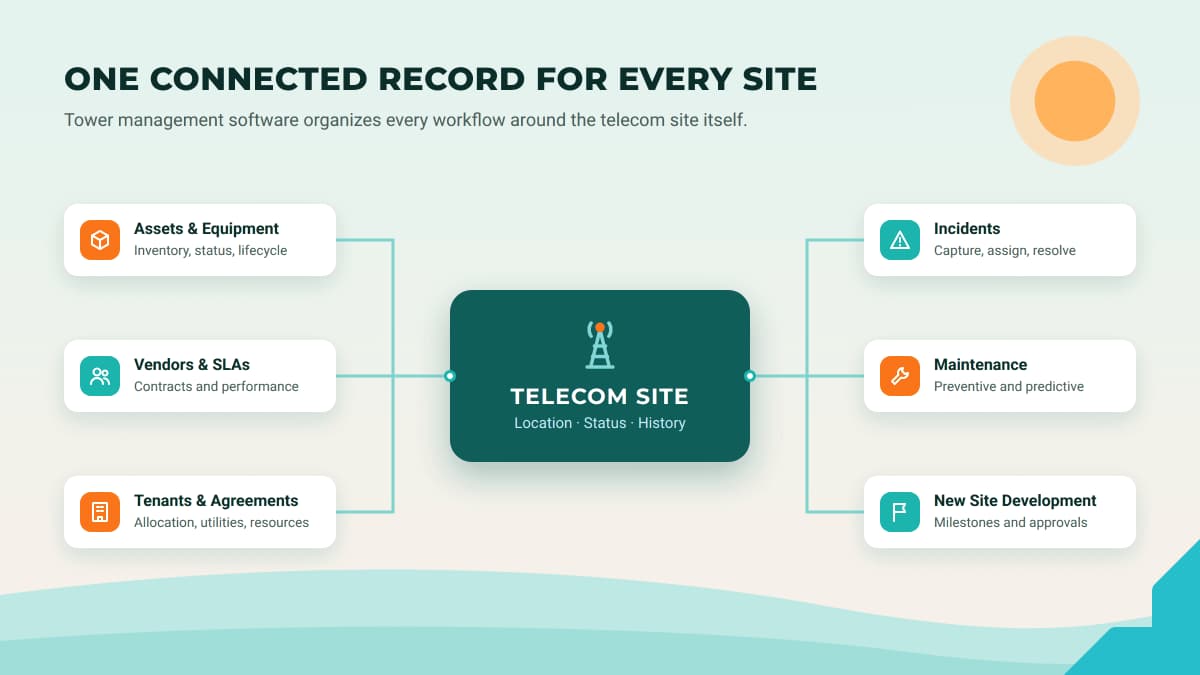
Telecom tower management software is a platform used to manage the operational, physical, and administrative activities associated with telecom towers and sites. It provides a centralized system for managing site information, telecom assets, infrastructure, vendors, tenants, maintenance activities, incidents, and new site development.
Rather than maintaining separate records for different aspects of a site, teams can use a tower management system to establish a more consistent view of their infrastructure and the activities taking place across it.
Depending on the organization and scope of the platform, telecom tower management software may also be referred to as telecom site management software, tower site management software, telecom infrastructure management software, or a tower management system.
The objective is broadly the same: make it easier to operate a distributed telecom infrastructure portfolio with better visibility and control.
Why Does Telecom Tower Management Become Difficult at Scale?
Managing a few sites is very different from managing hundreds or thousands of geographically distributed locations.
A single telecom site may involve multiple assets, contractors, maintenance activities, utility requirements, tenants, service-level agreements, compliance requirements, and operational incidents. Each of these generates information that needs to remain accurate throughout the site's lifecycle.
Problems arise when that information sits across different systems or is managed independently by different teams.
An asset register may show equipment installed at a site, while maintenance records sit elsewhere. Vendor information may be maintained by another team, and incident details may exist in emails or a separate ticketing application. Site development teams may use their own project trackers.
The challenge is therefore not simply storing more information. It is connecting the information and workflows involved in running each telecom site.
This is where tower and site management software becomes useful.
How Does Telecom Tower Management Software Work?
A telecom tower management platform creates a common operational layer across telecom sites.
Each site can have a digital record containing relevant information about its location, infrastructure, equipment, vendors, tenants, maintenance history, incidents, development activities, and other operational data.
Workflows can then be built around that information.
For example, an incident reported at a telecom site can be recorded against the relevant location and asset. The appropriate team or vendor can be notified, resolution activities can be tracked, and the resulting maintenance history can remain associated with that site.
Similarly, when a new site is being developed, teams can track milestones, resources, contractors, regulatory requirements, and progress from planning through deployment.
Instead of treating asset management, maintenance, vendor management, and site development as isolated activities, the platform connects them around the telecom site itself.
Key Features of Telecom Tower Management Software
The capabilities required will vary depending on the size and operating model of a telecom organization. However, there are several areas that a comprehensive tower and site management platform should address.
1. Telecom Asset and System Management
Telecom sites contain a wide range of assets, from network equipment and power infrastructure to generators, utilities, and other physical systems.
Tower management software provides a centralized inventory of these assets and helps teams understand what is deployed, where it is located, and its current status.
A strong asset management capability should support:
- Centralized asset records
- Site-level asset visibility
- Equipment and infrastructure tracking
- Asset status and maintenance history
- Lifecycle information
- Performance data and analytics
Having this information available in one place becomes increasingly important as site portfolios grow.
2. New Telecom Site Development
Developing a new telecom site involves considerably more than selecting a location and installing equipment.
Site planning can involve contractors, engineers, resources, timelines, approvals, regulatory requirements, environmental considerations, and multiple project milestones.
Telecom site management software can provide a structured workflow for managing this process from planning through execution.
Teams can track milestones, responsibilities, resource allocation, documentation, and progress while maintaining a clear record of the overall development process.
3. Vendor and Service Provider Management
Telecom site operations often depend on external vendors and service providers for installation, maintenance, utilities, field services, and other activities.
Managing these relationships becomes more complex when different vendors operate across hundreds or thousands of sites.
A tower management platform can help organizations maintain vendor information, track contracts and service-level agreements, monitor performance, and connect vendor activities with the sites they support.
This makes it easier to answer questions such as:
Which vendor is responsible for this site?
What SLA applies to this incident?
How is a particular service provider performing across multiple locations?
When this information is connected to operational workflows, vendor management becomes part of site operations rather than a separate administrative exercise.
4. Tower Tenant Management
For infrastructure providers and TowerCos supporting multiple tenants, tenant management is another important part of tower operations.
Software can help manage information related to tenant agreements, site allocation, utilities, available resources, and the infrastructure being used at each location.
This provides better visibility into how individual sites are being utilized and helps teams coordinate shared infrastructure more effectively.
5. Incident Management
Incidents at telecom sites can directly affect service availability and operational performance.
A tower and site management system can provide a structured process for capturing, assigning, escalating, and resolving incidents.
Rather than relying on manual communication between teams, workflows can automatically notify the relevant people, assign responsibilities, track resolution status, and maintain an incident history for each site.
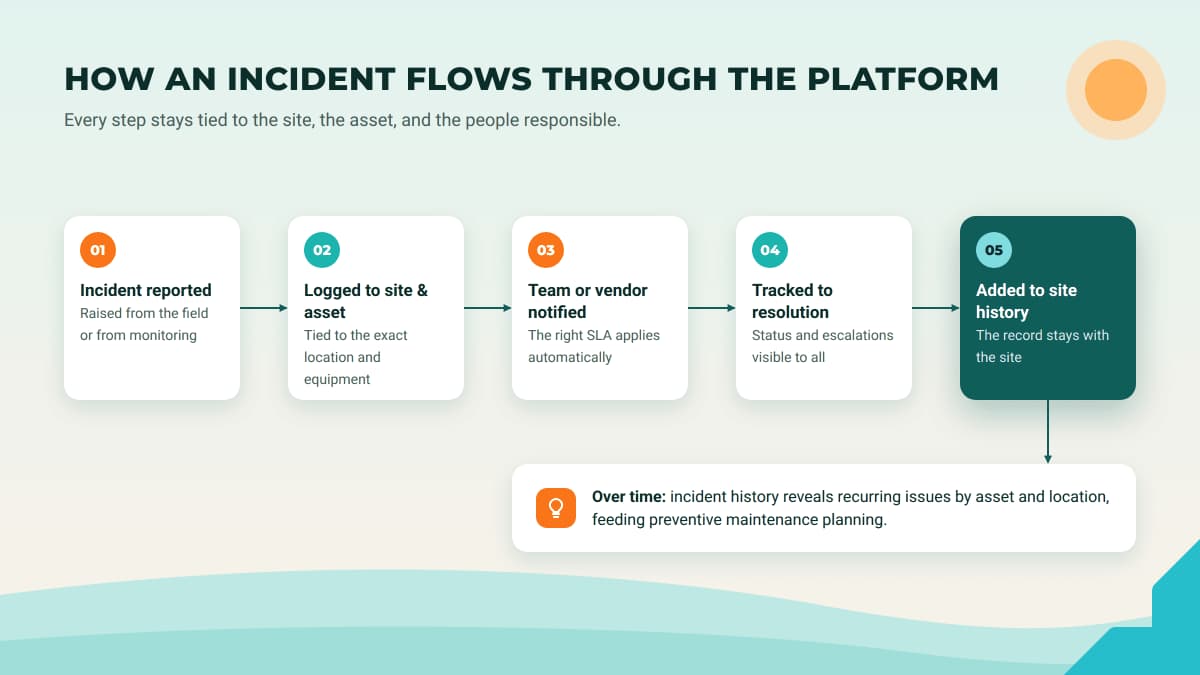
Over time, this data can also help identify recurring problems associated with particular assets, locations, or infrastructure.
6. Preventive and Predictive Maintenance
Waiting for equipment to fail before acting can increase downtime and maintenance costs.
Tower management software can help organizations move toward more proactive maintenance by combining maintenance schedules, asset information, historical incidents, and operational data.
Routine maintenance can be scheduled automatically, while analytics can help teams identify assets or sites that may require attention.
Where sufficient data is available, predictive approaches can help identify potential maintenance requirements before they develop into larger failures.
The result is a shift from simply responding to problems toward managing the health of telecom infrastructure over time.
7. Analytics and Reporting
Operating a large telecom site portfolio generates significant amounts of operational data.
The value of that data comes from being able to use it.
Dashboards and reports can provide visibility into areas such as:
- Asset health
- Maintenance activity
- Incident trends
- Vendor performance
- Site utilization
- Development progress
- Operational costs
This gives infrastructure and operations teams a more consistent basis for identifying issues and making decisions.
What Are the Benefits of Telecom Tower Management Software?
The biggest benefit is not simply digitizing existing records. It is improving how information and work move across telecom site operations.
Better Visibility Across Telecom Sites
Centralized site and asset information makes it easier for teams to understand what is happening across their infrastructure without gathering information from multiple sources.
Reduced Downtime
Structured incident management, scheduled maintenance, and better asset visibility can help teams identify and address operational issues faster.
More Proactive Maintenance
Maintenance teams can move beyond purely reactive repairs by using asset history, schedules, and operational data to plan interventions earlier.
Improved Vendor Accountability
Connecting vendor information, SLAs, site assignments, and performance data gives operators better visibility into external service delivery.
More Consistent Site Development
Standardized workflows help new site development teams manage milestones, responsibilities, resources, and compliance requirements more consistently.
Better Use of Infrastructure
Visibility into assets, tenants, utilities, and site resources helps organizations understand how infrastructure is being used across their portfolio.
Lower Operational Complexity
Instead of teams maintaining multiple disconnected trackers and processes, a common platform can provide a consistent operational framework across sites.
Who Uses Telecom Tower Management Software?
Tower and site management platforms can support several types of organizations involved in telecom infrastructure.
Telecom operators can use them to manage distributed network sites, equipment, maintenance, vendors, and infrastructure operations.
Tower companies (TowerCos) can manage tower portfolios, tenants, assets, maintenance, and site utilization.
Telecom infrastructure providers can coordinate infrastructure deployment and ongoing site operations across multiple locations.
Managed service providers and field service organizations can use site information and workflows to coordinate maintenance and operational activities.
The exact configuration of the platform will depend on the organization's operating model, number of sites, existing systems, and processes.
What Should You Look for in Telecom Tower Management Software?
There is no single platform configuration that will suit every telecom organization. However, buyers evaluating tower management software should look beyond a checklist of individual features.
The more important question is whether the platform can connect the different processes involved in operating telecom infrastructure.
A platform should ideally provide:
- Centralized management of telecom sites and assets
- Support for multiple asset and infrastructure types
- Site development and project workflows
- Vendor and SLA management
- Tenant management
- Incident and maintenance workflows
- Automated notifications and task management
- Reporting and operational analytics
- Integration with existing enterprise and telecom systems
- Appropriate security and access controls
- Flexibility to adapt workflows as operational requirements change
Scalability also matters. A system that works for a small portfolio should be capable of supporting significantly larger operations without requiring the organization to rebuild its processes.
Why Integration Matters in Telecom Site Management
Tower management software rarely operates in isolation.
Telecom organizations may already use enterprise applications, network systems, finance platforms, field service tools, document repositories, and other operational technologies.
A tower and site management platform should therefore be capable of integrating with the existing technology environment.
Integration reduces duplicate data entry and allows information generated in one part of the organization to support workflows elsewhere.
For example, asset information can support maintenance workflows, incident information can contribute to asset history, and vendor performance can be assessed against operational activities.
The goal is not necessarily to replace every existing system. It is to create a more connected way of managing the work that happens across them.
Can Low-Code Be Used for Telecom Tower Management?
Yes. Low-code platforms can be used to build and adapt telecom tower and site management applications, particularly when organizations need workflows that reflect their own operating processes.
Telecom infrastructure operations can differ considerably between organizations. Approval structures, maintenance processes, vendor models, reporting requirements, integrations, and site development workflows may all vary.
A low-code approach allows organizations to configure and evolve these workflows without relying entirely on lengthy traditional development cycles.
It can also make it easier to integrate site operations with existing enterprise systems and modify workflows as business requirements change.
Moving from Disconnected Site Operations to a Unified Platform
The complexity of telecom tower management rarely comes from one individual process. It comes from the number of processes, assets, organizations, and people that have to work together across a distributed infrastructure portfolio.
Managing assets in one system, maintenance in another, vendor information elsewhere, and site development through separate trackers may work initially. It becomes harder to sustain as the network grows.
A unified tower and site management platform provides a way to connect these activities around a common view of each site.
LOWCODEMINDS' Tower and Site Management Solution helps telecom operators, infrastructure managers, TowerCos, and service providers manage telecom assets and systems, new site development, vendors and tenants, incidents, and maintenance through a centralized platform.
Explore the LOWCODEMINDS Tower and Site Management Solution →
Telecom tower management software is a platform used to manage telecom sites, infrastructure assets, vendors, tenants, incidents, maintenance, and related operational processes from a centralized system.
Tower management generally focuses on the infrastructure and operations associated with telecom towers. Telecom site management can cover the wider site, including equipment, utilities, vendors, tenants, maintenance, incidents, and site development.
It helps teams manage incidents faster, schedule preventive maintenance, maintain asset histories, automate notifications, and identify infrastructure that may require attention before failures occur.
Yes. Tower and site management platforms can integrate with existing enterprise and operational systems, allowing organizations to connect site operations without necessarily replacing their existing technology environment.
LOWCODEMINDS is a global leader in AI-led enterprise process orchestration and Knowledge Work Automation, transforming fragmented workflows into orchestrated, AI-driven decision systems that help enterprises modernize and scale business operations. Recognized as a Top Player and Contender in the ISG Provider Lens® Intelligent Automation Services 2025 (U.S.) study, the company is at the forefront of next generation automation and enterprise transformation.
LOWCODEMINDS helps enterprises transform knowledge intensive and compliance heavy enterprise value chains through trusted, governed, and scalable AI automation that delivers measurable operational and financial outcomes. Powered by App Labs, its dedicated innovation division, the company has developed 7+ Enterprise Value Chain Frameworks, 20+ reusable Agentic AI Accelerators, and 18+ enterprise ready solutions across industries including BFSI, Legal, Manufacturing, Retail, CCM, and Telecommunications.

Headquarters:
8, The Green Ste B, Dover, DE 19901.
[email protected]
(276) 451-3607
2026
LOWCODEMINDS | Privacy Policy